"The LORD is nigh unto them that are of a broken heart" - Psalm 34:18 KJV
Seeking God is not a coping mechanism. Terrible things in our lives simply open up our hearts to God's word, and help us recognize our sin nature and seek God. Then when you realize it's as simple as believing in Jesus Christ's substitutionary death, and you can defeat death and sin as well, then of course it would seem like a no brainer, because it is! It's the greatest news ever, that we can be reconciled to God and have a direct relationship with the creator of everything.
Actually it might be, but we shouldn't give it the negative connotation "coping mechanism". That suggests that there's no inner change and that it's just a coat of paint in someone's life. God helps us cope because His promises are tangible, true, and good. It's a lot deeper than a "mechanism", it's a change of heart.
1. Admit you are a sinner, because all have sinned and come short of the glory of God - Romans 3:23, Romans 3:10-12, 1 John 1:10, James 2:10
2. Realize the penalty for sin, which is death, hell, and eternal separation from God - Revelation 21:8, Romans 6:23, Galatians 5:19-21, 1 Corinthians 6:9, James 1:15
3. Believe that Jesus died, was buried, and rose again to pay for your sin - 1 John 2:2, Acts 16:30-31, Acts 3:19, Acts 10:43 Romans 5:8, 1 Timothy 3:16, 1 Peter 2:24, John 3:16, John 10:28, John 6:47, John 11:26, 1 Timothy 1:15, 2 Corinthians 5:21, 1 Corinthians 6:11
4. Trust Jesus Christ alone as your savior, nothing else - Ephesians 2:8-9, Acts 4:11-12, Romans 11:6, Matthew 7:13-14, Matthew 7:21-23
Pray this prayer:
"Dear Jesus Christ, I know that I am a sinner. I know that I deserve to go to hell, but I believe you died on the cross for me and rose again. Please save me right now and give me eternal life. I'm only trusting in you Jesus, Amen."
And if you believed this in your heart, you're now saved and have the Holy Spirit. First of all, rejoice because you've passed from death to life through the power of Jesus Christ and he will NEVER leave nor forsake you, no matter what. This is why "Gospel" means "good news". You have absolute freedom, and power over death through Jesus. The Holy Spirit will guide you into more understanding as you read the scripture, but you should first focus on knowing the person of Jesus. Jesus is also in the Old Testament symbolically and literally.
The important thing to note is that Christianity is not just doing good things, about turning your life around, etc. Christianity is first about believing the promise of God and His finished work on the cross, and then those good works can follow (but they don't have to, some are saved without works - Romans 4:5). We don't do work for Jesus or become obedient to him because we must to be saved, we do it out of love because we ARE saved.
And once you're saved, you're saved. There is no bad deed you could do to lose it, because there was no good deed you could do to earn it. Jesus says he will never leave nor forsake you, and he means it, and his promises are good forever and always.
Please don't take HN threads into religious flamewar. Regardless of your sincerity, that's what this amounts to on a large public internet forum. It's off topic, and we have to ban accounts that do it, so please don't do it again.
I fail to see how this is off-topic. The topic of the article is religious faith among young people, and the person I replied to expressed a want to find Christian faith. So how is it off topic? At least admit you're being a tad-bit dishonest.
You link the guidelines but I haven't broken a single one in this thread lmao. I admit some other times I've brought up faith may have been off-topic as it relates to the OP, but on topic as it relates to my reply.
The topic of the article is a demographic study. You swerved directly into religious material itself. That's not the same topic at all. It's also flamebait because if you advocate your religious views in this way you will provoke others into advocating their religious views in an equally (let's call it) dedicated way, and off the cliff we will go. This isn't hard to predict.
We have tons of respect for people's religious views but this is a large public internet forum.
Why do I deserve to go to hell? My life was and continues to be pretty boring: as a child I went to school, I did my homework and got good grades, later I went to college, and later still I got a Ph.D.. Then I got a job, I got married, got kids. I continue to go to work, I get paid, pay my taxes (if you prefer, "I render unto Caesar what's due to Caesar"). I don't steal or con people. I don't cheat on my wife. I don't take Lord's name in vain, because I don't swear in general. I honor may parents. I don't observe the Sabbath, I don't even know if it's supposed to be on Saturday on Sunday. I don't worship idols, either 2D or 3D, because I'm an atheist.
You can live a good life, but if you've transgressed the law at any point you're guilty of it all. Jesus himself said if you even look at a woman with lust your heart is guilty of adultery, or if you're angry at your brother your heart is guilty of murder.
"For whosoever shall keep the whole law, and yet offend in one point, he is guilty of all.” - James 2:10
"But the fearful, and unbelieving, and the abominable, and murderers, and whoremongers, and sorcerers, and idolaters, and all liars, shall have their part in the lake which burneth with fire and brimstone: which is the second death." - Revelation 21:8
"The thought of foolishness is sin: And the scorner is an abomination to men." - Proverbs 24:9
"But we are all as an unclean thing, and all our righteousnesses are as filthy rags; and we all do fade as a leaf; and our iniquities, like the wind, have taken us away." - Isaiah 64:6
I don't know about you, but I've BEEN unbelieving in my past, I've lied and sometimes still do, and I've thought foolishness and still do. So I've transgressed God's law, but it has been forgiven of me because I accepted God's plan of salvation, which is faith in Jesus Christ through His substitutionary death on the cross and bodily resurrection.
If you never broke God's law, you'd never die and you would completely earn your salvation. It's impossible for us, but it was possible for Jesus because he was God and born to a virgin, therefore he was fully man and fully God. His work on the cross makes it possible to be born again in this life, with his same duality (having our flesh and our spirit), and the promise that we will one day receive a new body without sin.
The point is, God is so entirely holy that we cannot be reconciled by anything that we do with our bodies, or "works". Faith is required to receive the gift Jesus Christ paid for, which is not something we do with our body, it's a spiritual transaction.
"For he hath made him to be sin for us, who knew no sin; that we might be made the righteousness of God in him." - 2 Corinthians 5:21
“Who his own self bare our sins in his own body on the tree, that we, being dead to sins, should live unto righteousness: by whose stripes ye were healed.” - 1 Peter 2:24
I can't say that you had me at "hello". In fact you lost me where the fearful deserve to burn in fire and brimstone just the same as the murderer. Really? The punishment for fear is to burn?
All people will be punished by eternal hell if they do not accept Jesus Christ. The default state of man is death and hell since the fall of Adam, but we can reconcile our sin with God through Jesus, who is called "the true and better Adam".
"Therefore as by the offence of one judgment came upon all men to condemnation; even so by the righteousness of one the free gift came upon all men unto justification of life." - Romans 5:18
When we trust in Jesus Christ our sin no longer defines us, and no longer has any power over us, because we've accepted Jesus Christ's atonement for those sins, and all of the sins of our life. We can never defeat sin on this earth, for as long as we have the flesh it has some power over us, and that is the struggle of the Christian life.
I've been fearful, I've been a liar, I sometimes still fear and still lie. But I trust in Jesus, that since through his power he defeated sin and death, and was resurrected, that he can do the same for me. So though I've lied, I'm no longer a liar, though I've feared, I'm no longer fearful. Until you are reconciled to God by belief in Jesus Christ, you are defined by your sin, and punished for your sin after death.
"Jesus said unto her, I am the resurrection, and the life: he that believeth in me, though he were dead, yet shall he live:" - John 11:25
You say this like step 3 is something you can choose to do. I couldn't make myself believe in the resurrection even if I wanted to, in the same way I can't make myself believe in any sort of afterlife, or believe that the sun won't rise tomorrow, or believe that I'm more handsome than Brad Pitt was in his prime.
I'm not ragging on you for your faith, but I've seen a few religious people suggest that belief is a choice and I don't see how belief possibly could be. I at times genuinely and deeply wish I could believe in the resurrection and in a compassionate god... hell right now I have a close family member whose health is degrading and is suffering in a way I feel is undignified and that they don't deserve. I wish so acutely that there was some sort of heaven and that they will be restored and I will be with them again. Even if there wasn't really a heaven I'd feel better right now believing that there was.... that's the rub though. These things are so fundamentally disconnected from my understanding of the world, I quite literally am incapable of believing in them.
I was exactly where you are for a majority of my life, my brother passed away when I was 14 and it didn't lead me anywhere good, only further from God. I was saved when I was 19 by accepting those steps outlined in faith, and praying that prayer. I didn't intellectually accept them as you suggest, I didn't say "that makes sense to me", I just simply took it on faith, and prayed that prayer to Jesus, asking to be saved.
"Trust in the Lord with all thine heart; and lean not unto thine own understanding. In all thy ways acknowledge him, and he shall direct thy paths." - Proverbs 3:5-6
By praying that prayer earnestly in your heart you commit your soul to Jesus, it's just like the thief next to Jesus on the cross:
"And he said unto Jesus, Lord, remember me when thou comest into thy kingdom. And Jesus said unto him, Verily I say unto thee, To day shalt thou be with me in paradise." - Luke 23:42-43 KJV
And I know it's hard to recognize your sin, and believe in the penalty for sin, without first believing in Jesus. Maybe I shouldn't put them into steps, because it's something that happens all at once. By accepting Jesus you accept the truth of God's word in the Bible, because Jesus is "the word made flesh".
"In the beginning was the Word, and the Word was with God, and the Word was God." - John 1:1
I can tell from your paragraph that you are not incapable of believing, so I will pray earnestly for your salvation.
You can't post like this here, regardless of what anyone else has posted. I've banned the account.
If you don't want to be banned, you're welcome to email hn@ycombinator.com and give us reason to believe that you'll follow the rules in the future. They're here: https://news.ycombinator.com/newsguidelines.html.
Pretty much this, there have been times in my career when I was prepared to do everything the right way, but deadlines and unrealistic expectations from people who don't even know what JavaScript is forced my hand, so the product was less pretty internally but still functioning.
For most people software engineering is about driving results, not making everything beautiful under the hood. Although it's nice to do that when you have time.
How much is it actually using the PDF and how much is just normal Chat GPT knowledge? I uploaded a KJV bible and it seems to be doing pretty good with theological issues, like it knows salvation is by grace through faith alone which is my litmus test for any theological program. However, it seems to be just as honed in as Chat GPT is without even uploading a PDF.
Try asking plain GPT-4 for a Bible verse in Greek. It will recite it for you accurately from memory.
I recommended a friend who is an engineer-turned-Catholic-priest take a look at it, and he was quite impressed with its ability to answer theological and philosophical questions; as well as its ability to explain the grammar of the Latin translation of a Bible verse (which it had recited from memory).
All that to say: I don't think you needed to feed it the KJV. :-)
It's clear that ChatGPT is used as the foundation model and that Chat PDF did some prompt engineering to make it focus on the contents of the PDF primarily. I uploaded a government form for family expense reimbursement, and then asked Chat PDF what the capital of France was. Its answer: "I'm sorry, but the answer to your question is not relevant to the content of this PDF file. However, the capital of France is Paris."
I went with a paper[^1] from the other camp, and although it did a good job of summarizing it, it was not good at answering specific questions, e.g. the type of proteins that were common in Asgard archea and eukariotes.
But to me, a tool like this has to be one of the coolest applications of ChatGPT.
I think maybe it has the data of the bible (and some theology and religion knowledge) already during its training. And these are the background for it to handle other texts. We should test it with some unique information, preferably different from common sense.
If you look carefully at Paul’s writings, you will notice that he never says that our righteousness comes from faith alone—only that it comes from faith apart from works.
Might need to wait for gpt5 for it to go more deeply into the topic :)
There is justification before God and justification before men. To be justified before God requires faith alone, to be justified before men requires faith and works. Justification before God = entrance into heaven, however, so works don't matter for salvation.
If we want Christians fellowship on this Earth, and rewards in heaven, it is good to do work.
All the while housing, healthcare, education, and the things that matter once you've achieved food prosperity are disappearing at a rapid rate. This makes people turn to their baser needs more often, food and pornography and other stimulus.
Hello! Using this Google App Script code makes it possible to do file requests (even anonymous ones) using Google Drive. The implementation provided uses user input to create folders within a specified folder but you can remove that feature pretty easily for anonymous uploads.
I've limited it to 100MB transfers but you can also remove that and test the limits for yourself. I've successfully done up to 200MB at one time which is pretty huge for being absolutely free and customizable.
I think the fear should be less about AI taking 100% of jobs but it should be AI making a single programmer do the job of 5, which would wipe a majority of the market out and make it a non-viable career option for most.
Companies are already bloated, imagine when they realize one overworked highly paid senior can replace 10 juniors.
If increased productivity equaled job loss, there would be two programmers alive today, doing the same job as the fewer than 10000 programmers using punch cards as we entered the year 1950.
A lot of projects today are not even greenlit because they would be too expensive to make. For instance, there are a lot processes in almost every country that require you to file paper forms, even though we have had web forms and databases for 25 years. This goes even for rich countries. If one programmer is able to do the job of 5 others, we will probably have 5 times as many systems to tend to now that businesses and institutions can afford them.
This is true for other domains also. My wife translates for an ecommerce business. A lot of what she does is very automated. The software she uses remembers all phrases she has translated and uses a word bank she manages for special parts and uses DeepL for new translations which are then only proofread and fine tuned. It's amazing how much stuff she can translate that way in a day (no idea how many thousands words). She is kind of managing and overseeing an AI (DeepL) and sanity checking the work. If this was 20 years ago one would probably need a translation department of 10-15 people to do the same work. However, her company would have never been able to justify that kind of cost. So, in my view: Software and AI made translators probably more than 10x more efficient in the last 10 years, however the amount of stuff that gets translated also increased 10 fold during this time.
Yep! I think this is both the optimistic case, and the version of the future that seems most likely to me.
I'm still a bit bummed about it, because just writing and structuring code is something that often brings me joy (and maybe your wife feels similarly about the actual translation work...), but at the end of the day, I realized well before all this AI craze that it really isn't the most valuable thing I do in my job.
> … instead of the 97% unemployment … we’re instead 30x as productive.
Economic productivity simply means output per worker. So, we could make 97% of the US population permanently unemployed tomorrow, and as long as the AI replacement labor yielded equal or greater proceeds to the remaining 3%, we’d see a colossal increase in “productivity.”
That would be in the interest of the 3% to do (or attempt), which is what makes the scenario so scary.
But that’s never happened in the past. Why should it happen now? The Industrial Revolution is used as an example because it was the biggest spike in productivity, but the general trend has been the same since the invention of tools. Agriculture, another perfect example, lead to others having time to produce things instead of hunting/gathering. It’s easy to grasp with the agriculture example that “unemployment” wasn’t even really a risk.
Sure, there will be niche sub-industries that will be erased by LLMs, and people who have those niche skills will suffer. This has always been the case with technological advances. And always, it has not disrupted the economy.
Perhaps the quantity of labour utilizing each new technology through time is a (n-shaped) parabola that intersects with the technology it replaced.
The fear that technological advances will cause mass unemployment and destroy labour markets has been common throughout history. Yet here we are at full employment. Maybe this time is different?
It is different this time. In the past automation effected some domains more and some domains not at all. People moved to those other domains. AI can run all the domains humans do and more that they can't.
>If increased productivity equaled job loss there would be two programmers alive today, doing the same job as the fewer than 10000 programmers using punch cards as we entered the year 1950.
The only reason it's not the case in this example is because computers at the time were a tiny early adopter niche, which massively multiplied and expanded to other areas. Like, only 1 in 10,000 businesses would have one in 1950, and only big firms would. Heck, then 1 in 100 million people even had a computer.
Today they've already done that expansion into all businesses and all areas of corporate, commerce, and leisure activities. Now almost everybody has one (or a comparable device in their pocket).
Already cloud based systems have made it so that a fraction of programmers and admins are needed. In some cases eliminating the need for one altogether.
There are tons of other fields, however, more mature, where increased productivity very much equaled job loss...
Have no doubt, we will find new places to put computers. In the 80's and even the 90's everyone said the same thing, "Why do I need a computer? I can do everything I do already without a problem?" Well, turns out with computers you could do 12 more things you can never considered. Consider the interoffice memo: it'd take what, 1-2 hours to get a document from one floor to another through the system? Cool, you can work on 2-3 projects at a time maybe, because that's all the bandwidth allowed. Along comes email and ups that to 5-6 because now the communications can be pretty consistent. It's still not perfect, because what if you're at lunch or the gym? Then came Blackberries and all of a sudden its 12-15 projects at once. Then Slack because you don't even have to think. Now add this.
Notice that during that time there weren't all of a sudden less programmers, or managers or sysadmins, if anything there's more. If anything everyone is even more stressed with more to do because of the context switching and 24/7. That's why this will do, I'd bet money on it.
I dunno, I feel like we've been trying to find new places to put computers for a couple decades now, and the effort is kind of losing steam. Every week there are threads about how useless a lot of these efforts are.
You just don't hear about all the computers, that's all. There's one on your car's key fob, and likely 100 more in the car. Your coffee grinder has one. So does your dishwasher. And your electric blanket.
>In the 80's and even the 90's everyone said the same thing, "Why do I need a computer? I can do everything I do already without a problem?" Well, turns out with computers you could do 12 more things you can never considered
Yeah. Also, unfortunately, it turns out those people in the 80s and 90s got it right. They didn't really need a computer - they'd better off without one. But as soon as we got them, we'd find some things to use them for - mostly detrimental to our lives!
If increased productivity equaled job loss, there would be two programmers alive today
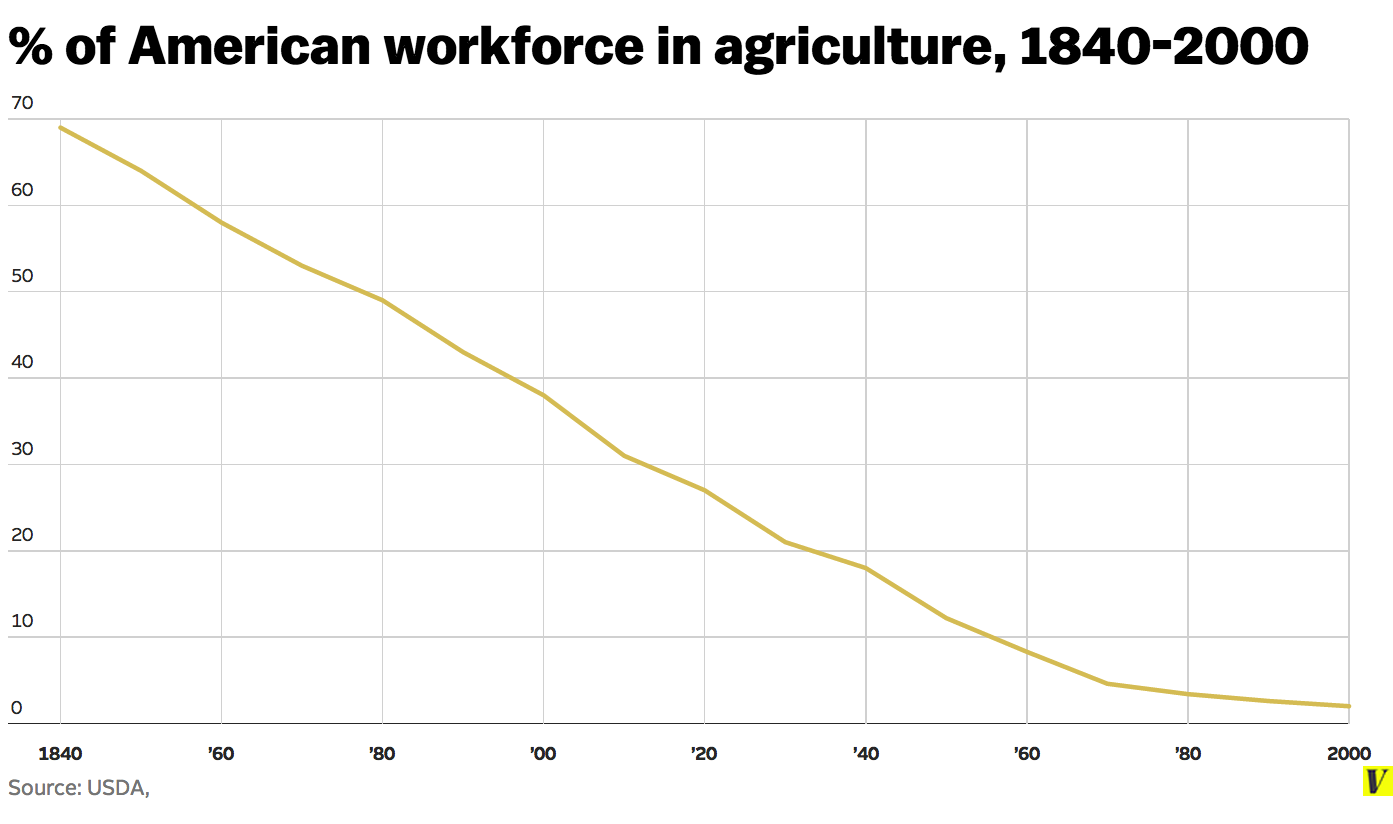
Increased productivity doesn't necessarily lead to overall job loss, but it will eventually in the area where the productivity is realized. Agricultural employment is a very clear example.
The US population increased about 15x in that period and one of the major reasons for that is the increase of productivity in agriculture [0]. Higher productivity created more demand.
> If increased productivity equaled job loss, there would be two programmers alive today, doing the same job as the fewer than 10000 programmers using punch cards as we entered the year 1950.
Yeah. The problem is that there’s only one of me. All the rest of you are filling in for the other guy.
yup just literally talked a client out of a nice little mobile project by telling him my rate. lets say I had AI by my side - I'd be quoting the same rate, but number of hours would be lower. project might be a go then.
> Companies are already bloated, imagine when they realize one overworked highly paid senior can replace 10 juniors.
Yep. This is where I'm at in terms of personal armchair predictions of the future.
I expect the labor market will be tough for more junior software engineers in the coming years. This might indeed cause backpressure in the supply of new grads/new labor force entrants in this family of fields ("software development").
However, the "highly paid senior" is only around for so long before achieving financial independence and just not working anymore. Then what? The company didn't hire juniors because the "highly paid senior" did all the work. Whoops. Now the company lacks the pipeline of people to replace that senior.
It'll sort itself out in time, but the next decade will be interesting I think. Some companies will realize that they must make investments into the future of the labor force and will do better in the longer term. Other companies might indeed "fire the juniors" for some short term gains and find themselves lacking replacement staff later.
I see it the other way around the senior engineer is expensive and costs a lot 2 juniors are cheap. Who cares if their code is crap they produce it really fast so they find a bug, just fix it quickly. If anything the time a Sr. spends thinking about things to do things "right" is seen as a waste of time. Whereas the jr. will produce an enormous amount of buggy code but they can fix the bugs quickly by just throwing another prompt to ChatGPT to solve.
Now some might say that the code will be terrible quality and buggy and full of holes and the users will hate it, it is never economically viable to build enormous systems on a house of cards like that. To which I respond, you just described every piece of enterprise software I've ever used ever.
Yes, this is also why senior engs get payed so well. Actually if you are junior dev you basically cost money, imo. However a lot of companies hire those in hopes they will make their career and stay longer - especially startups do that, as they can slide on the company culture hook way more. Also they need them as senior engs require equivalents of "secretary" to handle less import things.
I don't mean to sound mean, senior devs are also secretaries of their cto and so on.
Disagree -- I think chatGPT will make juniors more palatable to hire. ChatGPT will basically give juniors a free pair programmer to baby-sit their work/progress. Why pay extra for senior devs when juniors can become much more efficient thanks to ChatGPT becoming stack-overflow on steroids. I think the wage gap between junior and senior will actually drop massively. I predict teams will keep 1-3 architect level positions for designs and reviews and replace all seniors with cheaper juniors.
I really doubt that ChatGPT will be able to give the kind of guidance that turns juniors into seniors.
Getting juniors un-stuck on "simple" problems, maybe. Stack Overflow already does this. Image doesn't build? Search for the error message online. Don't know how to build the old software that only works in Ubuntu 14.10? Sure, you'll find that.
Suggestions on how to refactor, proper design of interfaces, what skill to acquire next? Maybe, but that will be a bigger surprise.
I think it could go either way depending on the product. For example in app/game/web development where code quantity > quality, hire more juniors who can bust out code with ChatGPT all day. But if you're developing software for medical devices, vehicle control systems, HFT, etc. Then nobody's going to let some college grad using ChatGPT touch it. You'd hire senior engineers who can be responsible for the reliable operation of the software and they can use ChatGPT for code review, test suites, etc.
Even in the gaming industry. Typically you have people developing an engine, common frameworks... tools that downstream work to lower branches - now I can just type to chatgpt rather than go through requesting/reviewing, see quicker where I mis-designed my "framework" etc... I am afraid it's gonna be not great for junior engs all together.
Every org has varying level of engineers. This technology will make cheap grind, well cheap. We see the progression. With the speed of changes it seems we should all be worried. (as why does it matter despite being last we fell a year after)
> Companies are already bloated, imagine when they realize one overworked highly paid senior can replace 10 juniors.
That is already possible without AI and has been the case for a long time... the issue is nobody will stay to be that highly paid senior running entire projects because at that point you can just run your own shop and pocket the full profits.
It also causes a "single point of failure". If that senior gets hit by a bus then what? Can the company afford to bring in another senior that will take ~6 months to become productive?
I'm not disagreeing with you. Im thinking of going solo myself.
I wanted to say the same thing - except that the senior can't actually perform 10x because they're too busy trying to train the next gen devs while attempting to deliver stories themselves in the fractions of time available to them.
Not to say that this is a bad thing, but the difference between a junior and senior is often much more than the difference in their salary.
Fixed pie fallacy. More likely, there will be 5x as many apps / companies with just as many jobs available. And the cost of everything will go down, except truly scarce things like Manhattan real estate.
Except, there was no AI, but an alternative called an offshored development center. You would send your spec and design document and get, via email or FTP if they were really cutting-edge a number of files that would sometime compile and even, according to the legends, actually work. The way this tech worked is that you generally had to wait overnight for your spec to "mature" into code.
Some places figured out they could hire local engineers for about 5-10x what they paid for this "offshored development center" tech and get better results.
I think this fear is unfounded because history shows this is not the case. We will adapt to the new level of productivity and our goals will adapt accordingly. What we are expected to produce will adapt. You were able to pump out 4 solid production grade pull requests per sprint? Then the expectation increases to a single dev being able to pump out 10. The company's ambition will grow as a result of the newfound efficiencies, and management will continue to request things that cannot be reasonably delivered on time with the people and tooling we have.
I don't know if that's going to be the case - companies can never have enough software and typically they just go until the budget runs out as the software is never "done". I think being able to build 5x the software with one dev means that each company is going to build 5x the software.
> imagine when they realize one overworked highly paid senior can replace 10 juniors
This already happens, the market is just not very efficient about it, e.g. a highly paid senior dev is not working at a company that only needs 2-3 developers, they're working at Google with 100's of devs.
Disagree -- I think chatGPT will make juniors more palatable to hire. ChatGPT will basically give juniors a free pair programmer to baby-sit their work/progress. Why pay extra for senior devs when juniors can become much more efficient thanks to ChatGPT becoming stack-overflow on steroids. I think the wage gap between junior and senior will actually drop massively. I predict teams will keep 1-3 architect level positions for designs and reviews and replace all seniors with cheaper juniors.
I predict the wage gap will actually widen. StackOverflow-on-steroids can only give your so much, so seniors will still be in demand for what they do. It's just the competition between juniors will be fiercer so junior wages will drop.
I think dev wages will stagnate across the board. I think the simple existence of the fear of being replaced by never-tiring, always-working AI will subconsciously prime devs to be willing to work for less. Devs have been in a market with a significant shortage of skilled labor; can we say that remains true after GPT hits the mainstream even more than it already has?
Right now? It made a splash but who uses ai for building their software this very moment? Nobody knows how the industry will land on this. Adoption will take time - it's not gonna be a year.
I remember after ruby on rails first demo, next day people had their websites up in ror. Here we will see, but it will be a bigger shift.
5X is a gigantic underestimate of how much developer time has improved. How long would it take a good assembly programmer to implement a CRUD web server connected to a database? Way more than 5x longer what a mediocre Python programmer would need.
> How long would it take a good assembly programmer to implement a CRUD web server connected to a database?
You know you can call import functions and call libraries in other languages than python? If everyone was programming in assembly then there would be plenty of libraries to make database calls or make web servers in assembly, and there would be plenty of tutorials online that you could copy and paste to get things going, meaning it wouldn't take much work at all. It would be more work, but not orders of magnitude more work.
Depends on the field kinda. For a really extreme case, something like big dense linear algebra is going to just use BLAS calls anyway. For big enough matrices, all of the flops are coming from the library, the cost of calling from Python vs the cost of calling from C or Fortran is amortized anyway, and probably most people won’t beat a tuned BLAS however much developer time they throw at it.
It makes more sense to tune libraries excessively, we could say it is less of a trade off, more of an allocation of the finite low-level tuning developer resources to high-impact libraries.
Anyway it turns out that the only way to get most people to link to a good BLAS is to use Numpy and distribute it through some giant Anaconda Rube Goldberg machine, so, I dunno, people are weird.
What does it even mean to say that a hypothetical assembly program is 500x faster than an existing Python program, when the assembly program does not even exist?
It's some kind of philosophical question.
Maintaining an assembly version of a modern software stack is not 5x more costly, it's simply not possible.
We should stop thinking about the trade-off as between developer time and CPU time. The CPU is an inanimate object which doesn't mind pushing around more electrons. What we're really throwing under the bus when we optimize for developer time is the customer's time.
If an inefficiency saves a developer 10 days of work, but results in an operation taking 100 milliseconds longer, and you have 50M customers who do that operation just one time, then you've wasted ~58 customer-days.
Good question. Why don't we pit one of today's Python programmers against an IBM VS assembler programmer on an IBM 360 system circa 1960 and see how far each gets in a week?
Let's make it more fair: what about one of today's Python programmers vs an IBM assembler programmer using Erlang/Elixir to develop a telephone switch?
I mean, I already do? And for totally mundane and benign reasons. This has been my experience in this industry for the last 8 years or so, though my first 9 years I felt like the pace was maintainable.
Do more with less. It's so common to come across situations where so and so left, their position won't be backfilled, the targets don't adjust to compensate for the productivity hit, and we can put up or shut up.
I'm kind of on the fence with this one. As someone who does programming at work,I don't want to be partially replaced by a prompt, however there are also lots of sectors, where the problems are big and solving them could help a lot of people but money is an issue,so being able to access resources on a scale of large tech companies would be amazing.
You're not thinking that companies will not just spin up 5 projects, so 5 programmers produce a notional 25 person's worth of work. And hey, maybe they sack the expensive old guy and the AI spend isn't so great. Seems like a win.
Wouldn’t this actually create more demand for programmers? More businesses can exist that have a need for software. To date every advance in programming efficiency has resulted in more tech, not less.
Additionally there’s the math behind it. If Company A fires 50% of their staff because AI lets the remaining 50% work at twice the productivity then how will they compete with Company B that keeps their staff and now gets 200% efficiency?
The math is in favor of getting more, not fewer, developers.
yes - and in another way, too. a lot of the demand for programmers is driven by successive waves of new technology adoption and investment - and AI is looking to be a motherload that should keep us going for awhile.
If you can have one programmer do the job of 5, then you will be defeated by companies using 5 programmers to do the job of 25.
Also, if your one programmer dies you now have no programmers and loss of all institutional knowledge, whereas the other company can lose several programmers and still be OK. There is value in having redundant programmers.
That would be awesome. We have a never-ending list of things to do and not enough time to do it all. What you're saying to me is that we can get through our list of priorities even faster, and stuff won't continually rot at the end of the list.
If as GP says AI could automate 1% of a single programmer's job (the boring part where you write code), then how on earth can you derive that a single programmer could do the job of 5 with AI? It's completely illogical.
If they indeed wait for input from other departments/companies 99% of the time (so they just need to actually program 5 minutes in their 8-hour workday), then they can be already thrown out of a job and have the company do with 1/10 the programmers, no AI required...
Clearly the company needs to dedicate a programmer to wait on each customer individually. You can’t have the same person waiting for two things simultaneously.


Seeking God is not a coping mechanism. Terrible things in our lives simply open up our hearts to God's word, and help us recognize our sin nature and seek God. Then when you realize it's as simple as believing in Jesus Christ's substitutionary death, and you can defeat death and sin as well, then of course it would seem like a no brainer, because it is! It's the greatest news ever, that we can be reconciled to God and have a direct relationship with the creator of everything.