It's basic economics in the sense that it's an oversimplified toy model. In the real world, every country I'm aware of gets a substantial amount of its tax revenue from consumption taxes, and indeed the US's lack of VAT means it's currently much more dependent on progressive income taxes than peer countries. (https://www.oecd.org/content/dam/oecd/en/topics/policy-sub-i...)
I responded to a comment that called progressive taxation a crazy “far left” idea - I’m not sure the second and third order details of taxation policy are really relevant here…
But ok - yes, sure, in real life it’s a mix and the mix is worth debating. Note also that consumption taxes often have exemptions/reductions to offset the most severe regressive effects.
Of course humans have a significant effect on climate change - the steelman versions of why that doesn’t matter are: 1) It doesn’t matter because we will figure out some technological solution in the future. Or 2) it doesn’t matter since I personally will be ok (because I am rich and/or live in a rich country that can afford to pay the costs)
I'm of the view climate change is real but not as big a deal as some people make out. A couple of reasons:
- Solar power has been growing exponentially for years and will continue for a while allowing carbon usage to be phased out and maybe carbon capture done.
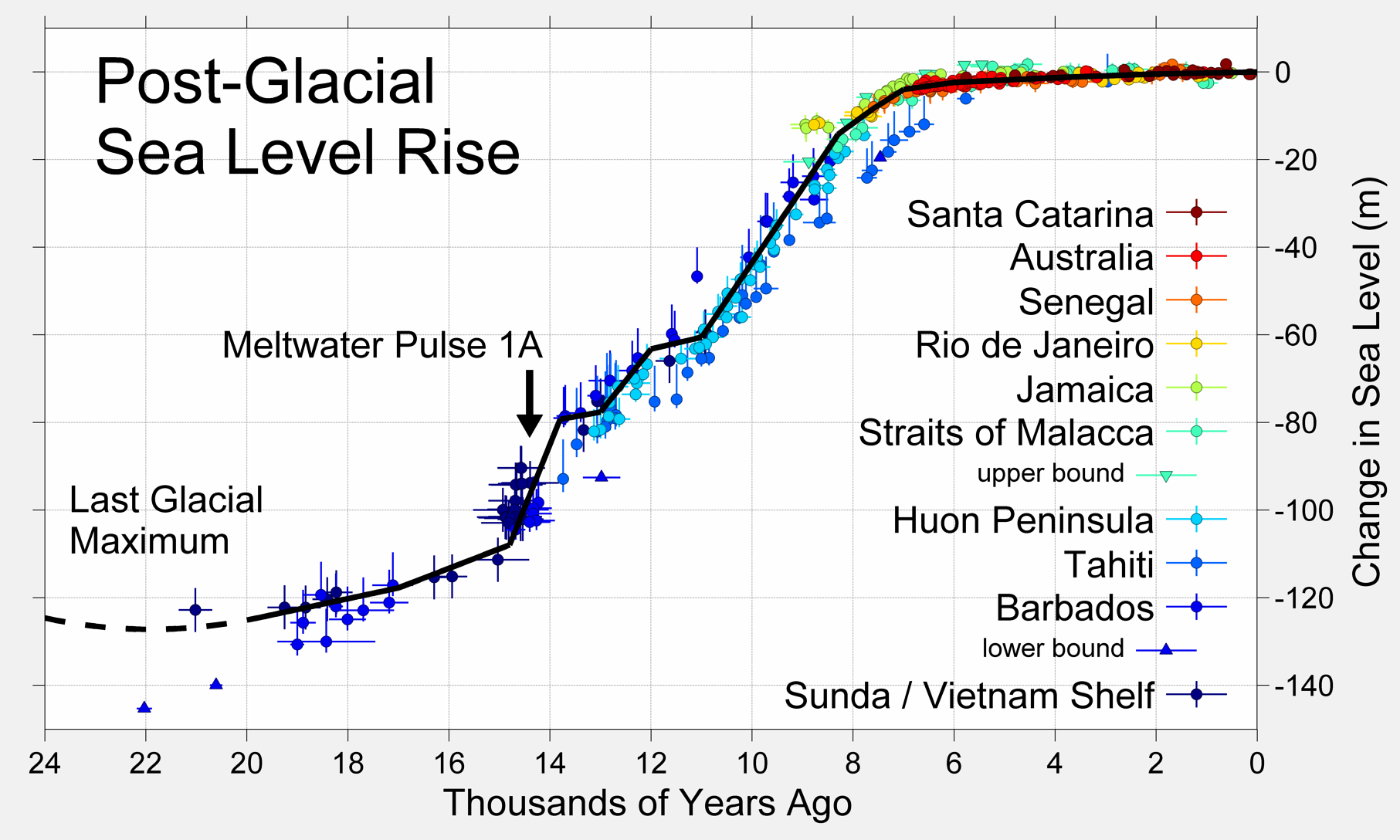
- The climate has changed naturally more than most people realise and life goes on. The sea is forecast to rise 60cm or so over this century but has risen ~120m over the last 20k years which was hardly noticed. (graph from wikipedia https://upload.wikimedia.org/wikipedia/commons/1/1d/Post-Gla...)
On point 2 - notice how flat your graph is for the last 6k years?
Also, why do you think the impact of past changes on a tiny group of humans living as hunter gatherers is of any relevance to 8 billion people living in the modern world (including, for example, in massive coastal cities?)
The US is the second largest manufacturer in the world - it's just moved into high end manufacturing. One of the difficult things about the current situation is how confidently wrong people are about the basic facts of the US economy.
For those who don't follow the link, here's an extract from the article explaining the core situation:
Imagine a car that costs $30,000 to produce before tax. Now compare four scenarios:
1) BMW sells the car in Germany (domestic sale): Germany’s VAT (let’s say 20% for simplicity) is added on the final sale. The German consumer pays 20% VAT, i.e., an extra $6,000, for a total price of $36,000. BMW forwards that $6,000 to the German government as VAT.
2) BMW exports the car to the U.S.: Since the car is exported, BMW does not charge German VAT. Any VAT BMW paid on parts or inputs is refunded by the German tax authority. The U.S. buyer pays the $30,000 price, and since the U.S. has no federal VAT, there’s no equivalent federal tax on that sale. (A state sales tax might apply at the point of sale, but we’ll come back to that.) The key point: the German government collects no VAT on an item consumed in the U.S.. This makes complete sense because that car’s being enjoyed by an American buyer, not a German resident.
3) GM sells the car in the U.S. (domestic sale): The U.S. has no VAT, so the American consumer pays $30,000 (ignoring any state sales tax). No federal consumption tax is collected. (In states with a sales tax, the consumer might pay, say, 7% extra to the state government, but again, the federal treatment is no tax.)
4) GM exports the car to Germany: When the car arrives in Germany, it faces the same 20% VAT as any car sold in Germany. So a German customer buying the American-made car pays $30,000 + $6,000 VAT = $36,000. That $6,000 goes to the German government. From GM’s perspective, it doesn’t owe U.S. tax on that export sale (since the U.S. doesn’t tax exports of goods), but its product will bear German VAT when consumed in Germany.
What outcome do we have here? In Germany, both the BMW and the GM car cost the same $36,000 after tax, and the German government collects VAT on both. In the U.S., both cars cost $30,000 before any state sales taxes, and the U.S. government collects no federal consumption tax on either. Each country taxes consumption within its borders—no matter where the product came from—and does not tax consumption outside its borders. This is precisely the goal of destination-based taxation: neutrality. Consumers in each country face the same tax on a given product, whether it’s domestically produced or imported. And neither country’s producers carry their home consumption tax as a “ball and chain” when they go compete in foreign markets.
There are different ways to allocate resources in a society. They have different trade-offs and failure modes, and the best systems try to solve problems using the right allocation mechanism (so, mining copper -> free market, building computers -> free market, water rights -> tightly regulated and/or government controlled, utility networks -> tightly regulated, setting interest rates -> independent central bank, national defense -> government controlled, and so on).
Reducing that to free markets = good, governments = bad (or vice versa) is a truly terrible way to think about effective society design.