Some of the other commenters have pointed this out. But this just doesn’t quite work.
I’ve been doing Game Dev for the better part of 15 years now which is almost all of my career. I’ve been almost solely focused on building Tools and almost always building Editor internals and the interactions with the engine/assets systems.
There’s just so so much nuance to how editing works. You also want to be as close to how the engine will render so there’s also the need to either embed or have an api on your game to edit content live. People need hot reloading, people need things to look and act correct.
Just rendering a model accurately can be a challenge. Don’t get me started on animations
> LIGO can't point to specific locations in space
Since LIGO doesn’t need to collect light from stars or other objects or regions in space, it doesn't need to be round or dish-shaped like optical telescope mirrors or radio telescope dishes. Nor does it have to be steerable, i.e., able to move around to point in a specific direction. Instead, each LIGO detector consists of two 4 km (2.5 mi.) long, 1.2 m-wide steel vacuum tubes arranged in an "L" shape (LIGO's laser travels through these arms), and enclosed within a 10-foot wide, 12-foot tall concrete structure that protects the tubes from the environment.
> A mirror at the vertex of the arms splits a single light beam into two, directing each beam down an arm of the instrument
Mirrors at the ends of the arms reflect the beams back to their origin point where they are recombined to create an interference pattern called 'fringe
It’s the simulation and fitness function that are difficul not the genetic algorithm really.
I’ve done a bunch of playing around with NEAT, a variant of GA using NNs, for various things. Typically for GA stuff though you have a genome, aka some set of instructions for an individual, a fitness function for scoring them, and then you generate new individuals from those genomes for the next population.
I love the NEAT algorithm. I did version of it for my senior project in high school, and have done a few iterations since, mostly with bugs that eat food and avoid predators. I'm about due for another round.
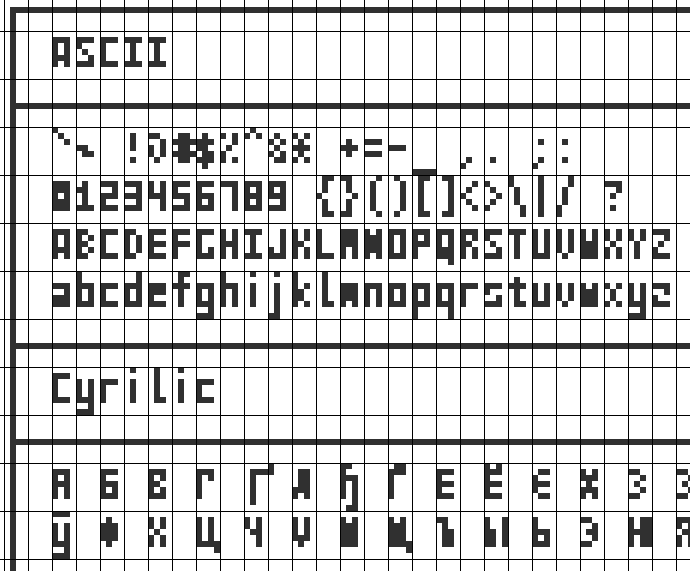
if you're in the market for something slightly bigger, I've found this font to be useful on lowish-res (640x480) displays: https://github.com/josuah/miniwi
The size of the characters in pixels is not given in their readme, nor could I find it easily in the config files. Can you tell me how big the characters in its readme are?
The lowercase "s" is only 4 px tall. The "f" and "y" add 2 px above and below, so the total reserved height must be 8px. Then 2 more px for whitespace, so 10.
Weird that the lowercase letters with ascenders are taller than normal uppercase, I didn't notice that. But yeah, the core numbers+uppercase box is 3x5 (with only "Q" violating that). And it's all on a 4x8 grid.
https://en.wikipedia.org/wiki/Qualia[1] - is what you are now describing mixed with a little bit of Maxwell's Demon[2] - something is intercepting between you and a true experience.
Real, in the way I believe you are trying to express, is a complicated topic.