C doesn't necessarily teach you how computers work. But it does teach you how software works. Our modern software empire is built on mountains of C, and deference to C is pervasive throughout higher-level software design.
>You may have heard another slogan when talking about C: “C is portable assembler.” If you think about this slogan for a minute, you’ll also find that if it’s true, C cannot be how the computer works: there are many kinds of different computers, with different architectures
As with many things, this phrase is an approximation. C is a portable implementation of many useful behaviors which map reasonably closely to tasks commonly done on most instruction sets. C programmers rarely write assembly to optimize (usually to capture those arch-specific features which are unrepresentable in C), but programmers in other languages often reach for C to write the high-performance parts of their code. The same reason C programmers in the early days would reach for assembly is now the reason higher-level programmers reach for C.
> Our modern software empire is built on mountains of C, and deference to C is pervasive throughout higher-level software design.
This I agree with and also I'd call the most important reason for Rust programmers to learn C. The C ABI is a lingua franca, not because it's good or pure but (as with spoken linguas franca) happened to be in the right place at the right time. It defines certain conventions and assumptions that didn't have to be assumed (implicit stack growth without declared bounds, single return value, NUL-terminated strings, etc.) and a lot of software is written to it, to the point that if you want your (e.g.) Python code and Rust code to interoperate, the easiest way is to get them to both speak C-compatible interfaces, even though you're not writing any actual C code.
Yup. In compiled-languages land it's common to see things that are API-compatible but not ABI-compatible: the compiled objects don't work together, but if you recompiled the same source code it would work with no changes. This happens (sometimes) when you do things like reorder members of a structure or switch to a larger integer type for the same variable.
C and libc have been ABI-stable on most platforms for decades. C++ on some platforms (e.g., GNU) is stable with occasional ABI breakages in the standard library; on others (e.g., MS Visual C++) it breaks with new compiler versions. Rust isn't ABI-stable at all and has no clear plans for it, despite a strong commitment to API stability (i.e., old code will compile on new compiler versions). Swift 5 is targeting ABI stability.
There is no difference inside the computer between those concepts.
For convenience, many architectures have a single assembly instruction for taking one register (called the "stack pointer"), adjusting it by a word, and moving a register to the address at that word, and a corresponding instruction to move data back to a register and adjust it in the other direction. That's the extent of the abstraction. You can implement it with two instructions instead of one, and then you get as many stack pointers as you want. Zero, if you want.
There is no "heap" on modern OSes. There used to be a thing called the program break, beyond which was the heap. It's almost meaningless now. You ask for an area of virtual memory via mmap or equivalent; it is now one of several heaps you have.
And you can pass around pointers from all your stacks and all your heaps in the same ways, as long as they remain valid.
You need to understand this in order to understand how thread stacks work (you typically allocate them via mmap or from "the heap"); how sigaltstack works and why you need it to catch SIGSEGV from stack oveflows; how segmented stacks (as previously used in Go and Rust) work; how Stackless Python works; how to share data structures between processes; etc.
I think this is lawyering a bit. There might not be a "heap", per se, but there is stack allocation (which is embedded all the way into the ISA) and "everything else". You can, after all, build a simple "heap" on top of an adequately large static buffer.
Since this is a distinction that is very important both for performance in high-level languages and for correctness in C, and one C forces you to think about and makes plain without having to reason through escape analysis and closures, I think the previous comment's point is well taken.
The distinction is important for apartmented thread models, such as those found on Windows, where you do have multiple heaps, and pointers allocated on one are not valid in another.
Stack allocation of return addresses is embedded in most ISAs- but stack allocation of local variables isn't (because that's not A Thing at the ISA level).
Consider, say, shadow stacks- local variables might end up living on a totally separate "stack" from the one "call" pushes onto and "ret" pops from, and one which the ISA has no idea about.
In what sense is stack-relative addressing, PUSH, POP, and addition/subtraction on the stack pointer not ISA-level support for stack allocation of local variables?
Addition, subtraction, and stack-relative addressing are, in most architectures I'm familiar with, generic- stack-relative addressing ends up just being a special case of register-relative addressing, and addition and subtraction are rather important instructions in their own right.
PUSH/POP are more obviously "hey store your locals on the stack, kids", but on, say, x64, how often do you actually see a push instead of bp/sp-relative addressing? Most compilers seem to be much happier representing each stack frame as "a bunch of slots, some for things where the address is taken so it needs to be in memory, and others where I spill things into as needed".
On ARMv7 (i don't know enough about v8 / AARCH64), "push"/"pop" are just stores/loads with postdecrement / postincrement.
Is this lawyer-y? Sure. But I think it's still correct, and this being HN...
On x86, push/pop have dedicated hardware optimizations known as the stack engine which perform most of the rsp increments/decrements and passes those offsets into the decoder, instead of using executions slots on them. push/pop are also much smaller than the corresponding mov/add instructions.
It's much more optimal to use a series of push/pops for smaller operations like saving registers before a call than to manually adjust and store onto the stack.
While technically this is still incrementing/decrementing a register and storing, the amount of isa/hardware support for such things clearly demonstrates that the x86 isa and modern x86 hardware gives special treatment to the stack.
There's a reason 32-bit ARM has 'move base register down and then do some stores' and 'do loads and then move base register up' (stmdb and ldmia) rather than just plain old ldm and stm, and I'm pretty sure it's because it makes the entry and exit sequences for function calls with a stack shorter. (The ARM ISA doesn't privilege a downward growing stack, so you can use stmib and ldmda if you want your stack to grow upward; the Thumb ISA, however, does want a downward stack for push and pop.)
That's definitely a large part of it, but it also makes small memcpys nicer (load sizeof(foo)/4 registers from sourceptr with post increment, store them to destptr with post increment)
They may not be distinguished at the instruction level, but if you’re trying to argue it’s not a useful thing to teach you’ve lost me. Dynamic vs static vs scoped (stack) allocation is incredibly important to reasoning about basic programs.
Like I established in my opening comment, C tells you how software works, not how hardware works. Regardless, you're still wrong in several ways here. Making it out of several discontinuous regions of memory doesn't make your heap less of a heap. Most architectures also provide instructions for loading data from the stack and optimize for this purpose, using their caches more efficiently and making design decisions which have clearly been influenced by the C (or System V) ABI.
And some, such as RISC-V, have no predefined stack pointer at all. (Push and pop are implemented by doing them manually; call is implemented by the jump instruction optionally taking an argument for a register to use as the stack.) C, at best, teaches you the C abstract machine, which supports both of these concrete implementations equally well.
There are no occurrences of the words "stack" or "heap" in this document.
What the spec actually discusses is "storage durations". Now, in many cases you can say, well, "automatic storage duration" means it's on the stack, but that's not something C has any opinions about.
If you want to know about the stack and the heap, saying "learn C, and then learn how these abstract C concepts map onto the stack and the heap" might not actually be the best way to figure this stuff out.
What actually ends up happening, in my experience, is that to figure C out you have to get a decent mental model of how the stack and heap work, and then, from that, say "automatic storage duration and malloc/free are basically just the stack and the heap".
I learned calculus as a kid because I needed it for an online electronics class I was taking. But I'm not going to recommend that folks take electronics classes so they learn calculus! (that said- having a motivation to learn something, having an application in mind, a problem you want to solve... certainly seems to make learning easier.)
Debates about the "stack" rage every couple of years on comp.lang.c. Invariably people conflate two different meanings: (1) an abstract data structure with LIFO ordering semantics, and (2) #1 implemented using a contiguous block of [virtual] memory.
The semantics of automatic storage necessarily imply #1, but they do not require #2. Indeed, there are widely used implementations which implement #1 using linked lists (e.g. IBM mainframes, and GCC's split stacks or clang's segmented stacks).
Similarly, function recursion semantics necessarily imply #1 for restoring execution flow, but not #2. In addition to the examples above, so-called shadow stacks are on the horizon which maintain two separate stacks, one for function return addresses and another for data.[1] In the near future a single contiguous stack may be atypical.
[1] Some variations might mix data and return addresses if the compiler can prove safe object access. Or the shadow stack may simply contain checksums or other auxiliary information that can be optionally used, preserving ABI compatibility.
And just going to throw out there that IA64 split the function return stack and data stack into different hardware stacks, so they've been out for twenty years at this point at least.
"C" doesn't just include the spec but also the customary semantics [1] of the language. The customary semantics certainly include the stack and the heap.
At some point, these conversations seem to always turn into a contest to see who can be the most pedantic. Which I think is pretty fun - and pretty well in the spirit of the original article - but that's me, and I can't fault anyone for being turned off by it.
's funny, I am certainly aware of having, at some point, at least skimmed over the C99 standard encountered the concept of a storage duration. But, aside from that brief few hours, virtually the entirety of my C-knowing career has been spent thinking and talking in terms of stacks and heaps.
Meanwhile, in my .NET career, I really did (and, I guess, still do) feel like it was important to keep track of how .NET's distinction is between reference types and value types, and whether or not they were stack or heap allocated was an implementation detail.
They just call stack allocation "automatic storage duration" in the spec. If you read it, you pretty much have to implement it as a stack; you just don't have to keep the frames contiguous in memory. They still need to maintain stack style LIFO access though, so the only spec compliant implementations that don't use a traditional stack have back pointers in each frame to maintain stack style LIFO semantics.
I think I only got a reasonable understanding on the stack and heap concepts when I got to make a compiler in my undergrad classes. Some 2 years after I learned C.
I'm not even sure the C memory model depends on the code/stack/heap separation.
Or passing by value vs passing a pointer, or the importance of memory management...
Modern languages solve problems created developing in legacy languages (primarily C). The issue is that knowing a solution without knowing the prior problem which the solution addresses, doesn't really lend itself to clarity.
They don't solve problems created by C, they just solve problems C doesn't. The problems still exist, and sometimes the high-level compiler even picks the wrong solution. Learning C helps you understand when and why this has happened.
Arguably those problems did not exist before the C-era as software wasn't large or complicated enough. C++ directly attempts to improve over C by providing new mechanisms to solve problems encountered by C developers every day.
Point is that out of context, a lot of the things modern languages provide seem superfluous. Why have objects? Why have templates, closures, or lambdas? For a novice programmer, these are many answers for questions yet to be asked.
When you come from a heavy C background and you encounter something like templates, you know EXACTLY what this is for and wish you had it years ago.
I'm as hardcore as they get C programmer and I'm having a ball with C# for this very reason.
When I see templates, I run in the opposite direction at a dead sprint. C++ has added very little of value to the language and templates are one of their worst offerings. Metaprogramming is an antipattern in C.
You can write bad code in any language, C is no exception. We also see people persistently arguing in favor of simpler and less magical C. If you want reliable, maintainable code in any language, do not use magic. Metaprogramming is cool, no doubt about it, but it's unnecessary and creates bad code.
There are many languages which have undefined behavior.
C does have a lot of it, and it can be anywhere. In many languages, you can cause undefined behavior through its FFI. Some languages, like Rust, have UB, but only in well-defined places (a module containing unsafe code, in its case).
If a language lets you cause undefined behaviour via FFI into C, I think it's fair to say that that remains a problem created by C.
I do take your point about Rust, but I'd see that as deriving from LLVM's undefined behaviour which in turn descends from C; I'm not aware of any pre-C languages having C-style exploding undefined behaviour or of any subsequent languages inventing it independently.
> I think it's fair to say that that remains a problem created by C.
That is fair, however, I don't think it's inherently due to C. Yes, most languages use the C ABI for FFI, but that doesn't mean they have to; it's a more general problem when combining two systems, they cannot track statically the guarantees of the other system.
With Rust, it has nothing to do with LLVM; it has to do with the fact that we cannot track things, that's why it's unsafe! Even if an implementation of the language does not use LLVM, we will still have UB.
> With Rust, it has nothing to do with LLVM; it has to do with the fact that we cannot track things, that's why it's unsafe! Even if an implementation of the language does not use LLVM, we will still have UB.
I can see that any implementation of unsafe Rust would always have assembly-like unsafeness (e.g. reading an arbitrary memory address might result in an arbitrary value, or segfault). But I don't see why you would need C-style "arbitrary lines before and after the line that will not execute, reads from unrelated memory addresses will return arbitrary values" UB?
> I don't see why you would need C-style "arbitrary lines before and after the line that will not execute, reads from unrelated memory addresses will return arbitrary values" UB
This reason this happens is because we don't compile things down to obvious assembly, they get optimized. Each of those optimizations requires assumptions to be made about the the code. If you break those assumptions, then the optimizations can result in arbitrary results happening. Those assumptions determine what is and isn't UB.
Most languages just don't give the programmer any way to break those assumptions, but languages like C and Rust do. Thus, Rust will always have this 'problem' because it can/will make even more aggressive optimizations then C will, meaning badly written `unsafe` code will have arbitrary behavior and results from the optimizer if the compiler doesn't understand what you're doing.
You are right that there's no inherent need for UB. However, we made the choice to have it.
The reason to have it is the exact same reason that the distinction between "implementation defined" and "undefined" exists in the first place: UB allows compilers to assume that it will never happen, and optimized based on it. That is a useful property, but it's a tradeoff, of course.
This is literally true but also overly reductive; we do make certain kinds of guarantees, even if there isn't a full specification of the entire language yet.
The reason that a spec is taking so long is that we're interested in making an ironclad, really good spec. Formal methods take time. C and C++ did not have specs for much, much longer than the three years that Rust has existed. We'll get there.
In my opinion as an onlooker of Rust, it seems more interested in shiny features and breaking the language every month than in becoming stable and writing a spec. It's far from replacing C in this regard.
What breaks in the language every month? That’s not the experience our users report. There are some areas where we do reserve the right to tweak things, but we take great care to ensure that these breakages are theoretical, rather than an actual pain. We have large (hundreds of thousands of LOC, and maybe even a few 1MM ones) code bases in production in the wild now, we cannot afford to break things willy-nilly.
You are right that we are far, but that’s because it’s a monumental task, and it’s fundamentally unfair to expect equivalence from a young language. It is fair to say that it is a drawback.
The language doesn't break as much today, but what constitutes "idiomatic" Rust is constantly changing. I don't use Rust but I spend a lot of time with people who do and am echoing what I've heard from them, and seen for myself as a casual user of Rust software and occasional drive-by contributor.
It doesn't have to be a monumental task. Rust is simply too big, and getting bigger.
But C never set out to be what it is today. It was a long time before anyone thought a spec was worth writing. For a language with the stated design goals of Rust, a specification and alternative implementations should be priority #1. You can't eliminate undefined behavior if you don't define any!
After recently (1 year) learning Rust I noticed that Rust teaches about low-level CS concepts of passing by value vs passing by pointer a lot better than C. Because you not just have references and values, but also have to think about richer semantics of what you are trying to do: sharing, mutability, and move semantics. So you learn not only that a few low level concepts exist, but you also learn how to use them correctly.
Memory management in C is very different than memory management in JavaScript, which throws exceptions when you try to access invalid memory, but will gladly let you create memory leaks inside event callbacks or other loops and keep chugging along gladly until it can't anymore. Writing a safe, efficient, high performing JavaScript app is very different than writing the same thing in C, and although I know both deeply well, I don't think learning C has helped me write better JS.
Just playing devil's advocate here... why is this such a "crucial" concept, for someone who is using a higher level language (like Python or Ruby)?
If 99% of what that person does is gluing together APIs and software modules, and they can see their memory usages are well within range, why does it matter?
I can’t make a thorough argument, but u/flyinglizard (in a comment adjacent to mine) mentioned what I was thinking: Ruby/Python almost entirely abstracts the concept of pointers, references, and memory. For beginners and intermediates, it’s not a big deal until you get mutable data structures like lists and dicts. When I learned CS, we were taught C/C++ first, and I remember the concept of mutability and object identity being not at all difficult.
Without being able to refer to fundamental structures and concepts, I usually just exclusively teach students non-mutable patterns (e.g. list.sorted vs list.sort), while pushing them to become much proactive at inspecting and debugging.
true. it's like interior decorator vs. interior designer
if you're just going to move couches around and put down throw pillows, who cares about a solid foundation of design fundamentals and architectural psychology.
It's also like fluid dynamicist vs quantum physicists. If you're just going to move oil around and put down differential equations, who cares about a solid foundation of quantum gravity and chromodynamics.
Yep. In truth, one can almost never win the argument of, "...but do I really need to know this?" But people should be aware that knowing fundamental things provides insight and advantages.
For sure, but there are diminishing returns. My rule of thumb is that understanding two levels of abstraction below whatever you're doing is usually worth it.
Compared to people who know only high level languages I have noticed that with my C background I can figure out performance problems better because I have an idea how the higher languages are implemented.
Because we haven't figured out a large body of non-leaky
or resilient abstractions yet. If a higher level construct was indeed a true superset of lower level functionality, or was robust enough to be applied to a wide variety of situations, then it would be okay. Right now in web software, because we optimize for development velocity so heavily, the tools a smaller product would reach for are fundamentally different from the tools a very high load service would. Until we can come up with a set of robust higher level abstractions that scale well (or better than they currently do) then we'll be stuck where we're at. Thread pools will saturate, GC will stutter, sockets will timeout, and all sorts of stuff that higher level abstractions do not capture well.
(I kept this post vague but can offer concrete examples of you'd like)
No. In the machine model used by Go, everything is allocated on the heap. The optimizing part of the compiler can then move allocations from the heap onto the stack if it can prove that the allocation does not escape the lifetime of a stack frame.
There are significant performance and strategy differences between the stack and the heap. On the stack, allocation is cheap, deallocation is free and automatic, fragmentation is impossible, the resource is limited, and the lifetime is lexically scoped.
On the heap, allocation might be cheap or it might be expensive, deallocation might be cheap or it might be expensive, fragmentation is a risk, the resource is 'unlimited', and the lifetime is unscoped.
Your statement is equivalent to saying "there's no difference between pointers and integers" - technically, they are both just numbers that live in registers or somewhere in memory. In reality, that approach will not get you far in computer science.
Those performance and strategy differences only exist inside C or other high-level languages, as a result of abstractions created by those languages. They are not in any way reflective of "the computer."
By all means it's certainly a valuable abstraction, one that most high-level languages support. But that's like how functions are a valuable abstraction, or objects, or key-value stores, or Berkeley sockets. Learning those abstractions is absolutely important and also completely irrelevant to understanding "the computer".
(As Dijkstra once said, computer science is no more about computers than astronomy is about telescopes. Learning C is valuable for computer science, but that doesn't mean it gives you a deep understanding of the computer itself.)
You are more than welcome to use a stack in an assembly language too. What you say certainly can be true, but many architectures include dedicated stack pointer registers and operations to manipulate them, either special-purpose (AVR, __SP_H__ and __SP_L__, push, pop) or more generic (x86 %sp, push, pop). I'd argue that functions exist at the hardware level to some extent too in architectures that support, for instance, link registers (PPC $LR) and special instructions (call, ret instead of a generic jump family). Calling conventions, sure, are an attraction over functions.
> Your statement is equivalent to saying "there's no difference between pointers and integers" - technically, they are both just numbers that live in registers or somewhere in memory. In reality, that approach will not get you far in computer science.
No, because in reality those are handled by different computational units. Integers are handled by the ALU, and pointers are handled by the loader. They are distinct things to the CPU.
Stack & heap have no such distinction. There isn't even a heap in the first place. There's as many heaps of as many sizes as you want, as the "heap" concept is an abstraction over memory (strictly speaking over virtual address space - another concept C won't teach you, yet is very important for things like mmap). It's not a tangible thing to the computer.
Same with the stack. It's why green-threads work, because the stack is simply an abstraction over memory.
> No, because in reality those are handled by different computational units. Integers are handled by the ALU, and pointers are handled by the loader. They are distinct things to the CPU.
I strongly disagree. Yes some execution units are more let's say "dedicated" to pointers than other, and obviously ultimately you will dereference your pointers, so you will load/store, but compilers happily emit lea to do e.g. Ax9+B and in the other direction, add or sub on pointers. Some ISA even have almost no pointer "oriented" register (and even x64 has very few)
Exactly, this will vary wildly between architectures. I would accept the statement on, for instance, a Harvard architecture but the world is a lot more nuanced in the much more common von Neumann architecture.
No no, haha, that's also not quite right. You can save the stack frame to memory then load it back which is what green threads do [1]. This includes the register state also, which is not what we're talking about here when we say "stack" -- we're referring to stack variables, not full frames. Full frames are even further from the heap, by virtue of including register states which must be restored also.
Although, it sounds like you're agreeing with me that there is in fact a difference between the stack and the heap because to your point one exists supported at the hardware level with instructions and registers, and one doesn't exist or can exist many times over. Hence, different.
> On the heap, allocation might be cheap or it might be expensive, deallocation might be cheap or it might be expensive,
In other words it might behave just like "the stack"; the differences between different kinds of "heaps" are as large or larger than the difference between "the stack" and "the heap".
> fragmentation is a risk, the resource is 'unlimited', and the lifetime is unscoped.
None of these is true in all implementations and circumstances.
Understanding the details of memory management performance is important for particular kinds of programming. But learning C's version of "the stack" and "the heap" will not help you with that.
I'd argue that given special purpose registers exist on most platforms to support a stack, and instructions dedicated to manipulating them (x86 %sp, push, pop) that the stack is in fact a hardware concept. The heap, however, is left as an exercise to the reader.
> I'd argue that given special purpose registers exist on most platforms to support a stack, and instructions dedicated to manipulating them (x86 %sp, push, pop) that the stack is in fact a hardware concept.
True enough; however sometimes access to "the heap" (in C terms) will use those instructions, and sometimes access to "the stack" will not. Learning one or two assembly languages is well worth doing, since they offer a coherent abstraction that is genuinely relevant to the implementation of higher-level languages. Not so C.
Well, you can just write a naive allocator that just bumps pointer and never deallocates things :). To appreciate stack vs heap, you have to learn a bit about memory management and some basic algorithms like dlmalloc, imho.
You're joking. There's a very serious distinction between the stack and the heap - perhaps they live in the same memory but they are used very differently and if you mix them up your things will break.
There is no hardware distinction between stack memory and heap memory.
In fact C teaches a model of a semi-standard virtual architecture - loosely based on the DEC PDP7 and/or PDP11 - which is long gone from real hardware.
Real hardware today has multiple abstraction layers under the assembly code, and all but the top layer is inaccessible.
So there's no single definitive model of "How computers work."
They work at whatever level of abstraction you need them to work. You should definitely be familiar with a good selection of levels - and unless you're doing chip design, they're all equally real.
I'm not sure it really pretends that there is so much a distinction so much as C supports stack allocation/management as a language feature, but heap support is provided by libraries.
Exactly. Maybe we could say that for 99% of software C is the lowest level. Its implemented in something, that's implemented in something, that's implemented in C. So, if you learn it, you can understand your software stack completely.
Also, C is learn once, write anywhere. If there is some kind of computer, then there is probably a C compiler for it. That's not true of any other language to the same extent. Know C and you can program anything.
Our popular software stacks are written in C and C++, but that's more because of history than anything else. I rarely reach for just "classic" C for performance anymore. These days I'm more likely to reach for GPUs, SIMD intrinsics (available in Rust), or at least Rust/Rayon for code that needs maximum performance.
C is fundamentally a scalar language. In 2018, the only code for which "classic" C is the fastest is code that exhibits a low level of data parallelism and depends on dynamic superscalar scheduling. Fundamentally sequential algorithms like LZ data compression, or very branchy code like HTTP servers, are examples. This kind of code is becoming increasingly less prevalent as hardware fills in the gaps. Whereas we used to have C matrix multiplies, now we have TPUs and Neural Engines. We used to have H.264 video codecs, but now we have huge video decoding blocks on every x86 CPU Intel ships. Software implementations of AES used to be the go-to solution, but now we have AES-NI. Etc.
As an example, I'm playing around with high-performance fluid dynamics simulations in my spare time. Twenty years ago, C++ would have been the only game in town. But I went with TypeScript. Why? Because the performance-sensitive parts are GLSL anyway--if you're writing scalar code in any language, you've lost--and the edit/run/debug cycle of the browser is hard to beat.
I'd argue that GPUs and SIMD instructions have so many restrictions that they're useless for general purpose computing. Yeah, they have niche spaces, but in terms of all the different kinds of programs we write, I think those spaces are going to remain niche.
Vectorised processing is a win according to that paper: it is faster than scalar code. The key point of the paper is that compiled queries---doing loop fusion---is sometimes more of a win (in a database context, where "vectorisation" doesn't always mean SIMD as in this discussion).
Doing fused SIMD-vectorised operations will likely bring the advantages of both, with relatively small downsides. This is a relatively common technique for libraries like Eigen (in C++), that batch a series of operations via "Expression Templates" and then execute them all in as a single sequence, using SIMD when appropriate. (Other examples are C++ ranges and Rust iterators, although these are focused on ensuring loop fusion and any vectorisation is compiler autovectorisation... but they are written with that in mind: effort is put into helping the building blocks vectorise.)
Depends on what you mean by "general purpose computing". Is machine learning general purpose? Are graphics general purpose? Is playing video and audio general purpose? If those aren't general purpose, I'm not sure what "general purpose" means.
GPUs and other specialized hardware aren't good at everything, and I acknowledged as much upthread, but the set of problems they're good at is large and growing.
I don't disagree with anything you said, but I wanted to point out you also don't disagree with the author. Your point ("this phrase is an approximation") is also the author's point. I felt he walked through the why fairly and with nuance.
I spent like a thousand dollars on the box sitting under my desk; I'm pretty sure my C code runs on special hardware too. ;)
(and worth noting: if I pull out the special hardware you're thinking of from that box, my particular thousand-dollar-box is no longer able to run software I need because the GUI requires a graphics accelerator card. The OS authors have already reached for a subset of CUDA to optimize the parts of the GUI that needed optimization).
On hardware level, all those use von Neumann architecture. Wasm, however, exposes Harvard architecture (implemented on top on von Neumann machines). Yet, you can compile C to Wasm, which is a data point about how abstract C is: so abstract that it can target Harvard architecture despite targeting just von Neumann architecture being sufficient for targeting modern hardware.
C is a useful and universal model of computation not just because most native software is ultimately built on C, but because any hardware that people end up widely using also has to have a sensible C compiler.
The C model is relatively close, I’ve heard, to the hardware of a PDP-11. But there have been tons of abstractions and adaptations on both sides of that coin ever since; not only can a C program provide a language runtime that behaves quite differently from a PDP-11, but the C program itself is compiled to machine code that is sometimes quite different than the code for a PDP-11, and even the low level behavior of the CPU often differs from what’s implied by the ISA. And while all of these models of computation are Turing equivalent, the transformations to and from C are very well known.
I like this article a lot. There are two ways you can think of looking at the field of programming:
* As a continuum from "low level" to "high level".
* As a giant bag of topics: strings, heap, hash tables, machine learning, garbage collection, function, instruction set, etc.
If your goal is to have a broad understanding of CS, you want to explore the whole continuum and many topics. C is great for that because it exists at a sweet spot that's lower-level than most languages but not so low level that you have to jump into the deep end of modern CPU architectures which are fantastically complex.
Because C has been so successful, there are few other successful languages that sit near it on that line. Those that are (C++, Rust) are much more complex. So if your goal is just to get familiar with that region of the continuum and not become an expert in a new language, C has a good price/performance ratio.
Also, it's a good language for getting exposure to many topics other languages hide. If all you know is JS or Ruby, C will teach manual memory management, static types, heap versus stack allocation, pointers versus values, primitive fixed-sized arrays, structs, and bit manipulation. Its sparse standard library means you'll end up implementing many common data structures yourself from scratch, so you'll get a better understanding of growable arrays, linked lists, trees, strings, hash tables, etc.
"Portable assembly" is a nice slogan for C. But it's worth remembering that back when it was coined, the emphasis was on "portable", not "assembly". At the time, C was an alternative to assembly languages, not higher-level languages.
It's never been very close to an assembly language. C has types while assembly is untyped. C has function calls that abstract the calling convention while assembly languages make that explicit. C implicitly converts between types, assembly doesn't.
I still don't understand why you should learn C if you really want to know "how the computer works". The author says "By learning C, you can learn more about how computers work", but why taking the long path if the short path exists? Just learn assembly language. It doesn't take that much time, a few weeks are enough to get a good insight into how simple CPU work (registers, memory, no difference between numbers and pointers, a stack that grows, etc.). Why spending time on learning C if you already know that this is not what you actually wanted? That's like wanting to learn German and then learning Dutch because you heard it's easier than German.
To all the people who are going to reply "But machine language is not how the CPU works!!1!!111": Yes, I know that real modern CPUs translate the machine code to something else internally and that they do things like register renaming and microinstruction reordering and they have ports and TLBs and instruction caches and data caches etc. But CPUs still have registers and an instruction pointer and most of them have a stack pointer and interrupts and exceptions. C will definitely NOT help you to understand those things.
> if you really want to know "how the computer works".
This depends on what the person is really trying to learn. If they are just interested in learning how a simple CPU does what it does, then, yes, going straight to an assembly language for some old chip from the 80s is a good idea. Writing an emulator is a fun and instructive exercise.
But my impression is that most programmers who want to learn how the computer works want to because they want to be able to write more efficient software. They want to understand how computer performance works. Learning a simple CPU is anti-helpful for that. It leads you to believe wrong things like "all memory access is equally fast".
If you want to learn how to write faster code, C is pretty good because it strips away the constant factor overhead of higher level languages where things like GC, dynamic dispatch, and "everything is a reference" mask hardware-level performance effects.
It lets you control layout in memory, so you can control data cache effects. Without a VM or interpreter overhead, most of the branches the CPU takes will be branches you explicitly write in your code, so you can control things like the branch predictor.
> if your goal is just to get familiar with that region of the continuum and not become an expert in a new language, C has a good price/performance ratio.
I think this is a particularly great point in your post. I wonder what AndyKelley thinks of this, as in my understanding, that's sort of what Zig is trying to do as well. That is, Zig is attempting to be a language on a specific spot on the price/performance ratio, as it were.
I agree with this characterization. Zig is trying to directly replace the niche that C represents, in terms of exactly this tradeoff.
So if Zig is successful, in 4 years the title of this post would have been "Should you learn C/Zig to 'learn how the computer works'?" and in 8 years the title would have been "Should you learn Zig to 'learn how the computer works'?". :-)
I think a new language has to be relatable with another and have some sort of huge defining feature(s) in order to get some sort of momentum, rust has rubyists(still one of my favorite languages)/c++ and safety, hopefully zig has something as well.
I teach C. It's an increasingly terrible way of learning "how a computer works". You would be much better off learning a little assembler.
The problem is most of the pain of learning C comes from undefined behaviour, which isn't how "computers work". The fact that depending on optimisation level writing past the end of an array might write to memory, or might not, is (mostly) a unique feature of C. Similarly sometimes a signed integer will overflow "cleanly", but then sometimes undefined behaviour will kick in and you'll get weird results. This (ironically) makes checking for overflow when adding integers in C annoyingly complicated.
With assembler if you write through a pointer, you write to that memory location, regardless of if you "should" be right now. You do multiplication or addition and you get well-defined 2s-complement wrap-around.
> You do multiplication or addition and you get well-defined 2s-complement wrap-around.
You get that, if that's what your CPU implements. Of course that's what all commonly used processors nowadays like x86 do. But C was meant to run on weirder ISAs as well. The specs of C allow so much undefined behavior in order to let C just emit the instructions for the multiply or memory access, and C deliberately says "not my problem" for whatever this architecture happens to do with edge-cases like overflow.
Using assembly instead of C cuts past the abstraction of the architecture, for both good and bad. You get defined behavior but lose portability. Practically speaking, yes, x86 assembly probably is a better way to learn without getting distracted by forty-year-old hardware oddities.
When I was learning assembly, one of my favorite things to see was what assembly got generated (more or less) from really, really simple higher level application code (C, C++, etc). Code consisting of really simple arithmetic, loops, function calls, object creation, etc.
As someone who felt that C was the path to knowledge for how modern computer systems "work", Forth and QEMU have become my "stretch challenge" for those with the motivation to tinker.
For me, working thru the resources on the OSDev wiki by taking jonesforth and linking it with the bootstrap from the "Writing an OS in Rust" tutorial (https://os.phil-opp.com/) really showed me how far C is from the hardware, and how much closer Forth connects to the idiosyncrasies of a computer system. Further, the immediacy of the Forth REPL can help with little experiments and building up the understanding of how much a machine's architecture influences code/data structures, opcode choice, privilege management, etc.
Plus, understanding Forth will bend your brain in a very strange but positive way :)
I’m convinced that Forth is a valuable intellectual exercise.
Can you elaborate on how you feel Forth better matches how a computer actually works? I’m not yet convinced on that point, but I have no Forth experience.
The most fun, in a tinkering sense, that I've ever had with low level programming was in a variant of Forth (within Minecraft, years ago when the mod that included it was still up to date).
That experience made me regret that Forth wasn't part of my formal education experience: it is a wonderful slightly above assembly language.
Forth is what should be included in a BIOS as the absolute lowest level interpreted language. A basic machine abstraction could be made by using only interpreted functions/procedures and that could be used to bootstrap add-in routines for attached hardware. It would be very possible to write low level bootstrap drivers that could be used on any architecture providing the specification (including some interface hooks for defining how to register and use an IO interface).
I've had the pleasure to interact with it while trying to get a SPARC Ultra 60 workstation to work. The driver hooks missing from most modern hardware meant that not all graphics cards could be used with full support - currently BIOS drivers provided on some PCI hardware (RAID, network adapters) are only for the x86 architecture. I forgot what they are called though...
I'll refer to jonesforth [1], but I think the lessons apply to the other Forth's I've seen.
The main core of a Forth is generally written in assembly to bridge the specifics of a processing unit and the canonical Forth words. For instance, most control flow words are defined in Forth, but a couple critical ones are implemented in assembly and "exported" up to the higher level words. [2]
The main task of the core is to bootstrap to a sufficiently powerful yet abstract dictionary of words that will allow a full Forth to flourish. But to get there, you'll have to make a lot of choices that will be constrained by your chip (Intel x86, x86_64, ARM, Z80, etc). The big one is type of interpreter (direct threaded, indirect threaded, etc).
In jonesforth, check out the docs and implementation of NEXT [3]. The choice was guided by a quirk of the Intel instruction set that allowed loading the memory pointed by esi into eax and incrementing esi all in one step; further, Intel x86 allows an indirect jump to the address stored in a register (eax). Not all instruction sets support this pattern, you'll have to experiment and investigate for various chips.
That choice is a critical one, but it's one of many. Where do you store the dictionary of words? How do you implement DOCOL? What registers will you preserve? Why? What instructions will you expose? Which ones will you hide? Will you allow new words to be created with machine code?
In C, much of this has been decided by others decades ago (existing operating system ABI choices, mainly). In Forth, you can try things out and only be restricted by the chips, which is what all of us are ultimately constrained by, even fancy-pants languages like Rust and Go :)
Once you get past the core into Forth, some of the computer details recede, but you usually have to be somewhat aware of how you are using the system, far more than modern programming languages. Forth is the ultimate deep-dive "language" [4], but that is as much a curse as a blessing.
Basically, use Forth for the understanding it provides, then go back to making good software in typical languages aided by the enlightenment you've attained :)
I agree about the benefits of a Forth-like language for tinkering. It's still very simple (like C), but the execution model is totally different, simpler, and more functional/mathematical.
I learned the HP programmable calculator version of Forth as one of my first languages, and I loved programming in that model. I think one's brain loses some flexibility if it hasn't programmed in a nonstandard model from an early time.
back in the 1980's when I first got into programming I wrote a 3D flight simulator in Forth ... terrific language ... loved teaching myself how to construct multi-dimensional data structures when the language itself only offered 1D arrays ... back pre-internet folks had to roll up their sleeves and write the plumbing level logic themselves unlike today with endless libraries at hand
It's hard to share, unfortunately, but I would recommend trying it out yourself regardless. The journey was more rewarding than the destination, at least for me.
In my case, the destination was a very simple Forth interpreter that read input from the serial port and sent a single packet over the virtual NIC interface. There are so many ways to go, that just happened to be my choice.
What really made computers click to me was reading a book that had the premise: "learn just enough assembly to be able to implement C features by hand; we'll show you how". Sadly, I don't remember the title.
Another revelation much later on, was, as discussed here, the realisation that C is indeed defined over an abstract machine. I think much of those realisations were because of reading about how crazy compiler optimizations can be and how UB can _actually_ do anything.
>When GCC identified “bad” C++ code, it tried to start NetHack, Rogue, or Towers of Hanoi. Failing all three, it would just print out a nice, cryptic error message.
The description is a little off. It was more a C thing than a C++ thing. And it was invoked by using any pragma; the gcc developers at the time had borderline religious objections to the idea of pragmas.
Nice! As of a couple months ago I'm actually going through the anime series again with my 9 year old. It's interesting getting his take on the characters, since it's a bit different than mine (and he's way younger than I was when I first watched it). For example, he's mostly bored by any Zoro fights, likely because at this point they are a lot of before and after cuts, but Zoro was always one of my favorite characters. We'll see if that continues, we're only just finishing the Spypeia arc.
I will say, waiting until he was capable and willing to read the subbed version was probably the right choice. Dubbed shows of any genre drive me nuts, and I'm not sure he would have the patience for the series if he was younger (the Alabasta arc was still taxing...). I do take a perverse pleasure in hinting about how crazy stuff becomes later, while also convincing him to not ruin it for himself by looking it up. ;)
One valuable property of C that the author didn't hit, C code is easily translatable into assembler in your head. He kind of misses this point with the virtual machine discussion. Yes C code becomes different types of assembly by platform, but you can look at C and have a clear idea of what the assembly will look like.
This is at a really good level for driving intuitions about what the computer is actually doing. Your concern 99% of the time when you are trying to think at this level is performance, and thinking in C will give you the right intuition about how many instructions your code is generating, what and when memory is being allocated, and which exact bytes are being pulled off the disk for certain function calls.
Modern swift/java/javascript compilers are so good that they will often generate better code than you write. This often makes knowing C a less useful skill. But, even so, when trying to understand what a compiler optimization is doing, you are probably thinking in terms of the C code it is generating. It's at exactly the right level to be clear about what is actually happening without drowning yourself in JUMP statements.
> Your concern 99% of the time when you are trying to think at this level is performance, and thinking in C will give you the right intuition about how many instructions your code is generating
I really don't think that's true given modern optimizing compilers. I remember back when C "best practices" were:
* Avoid moving code out into separate functions since calls are expensive.
* Hoist subexpressions out of loops to avoid recomputing them.
* Cache things in memory to avoid recomputing them.
But inlining means now we refactor things into small functions and usually expect that to be free. Optimizers automatically hoist common subexpressions out of loops.
And caching is useful, but making your data structures larger can cause more data cache misses, which can be more expensive that just recomputing things. I've seen good CPU cache usage make a 50x difference in performance.
Even in C, optimizing is now an empirical art and not something you can reason about from first principles and running the compiler in your head.
> One valuable property of C that the author didn't hit, C code is easily translatable into assembler in your head. He kind of misses this point with the virtual machine discussion. Yes C code becomes different types of assembly by platform, but you can look at C and have a clear idea of what the assembly will look like.
I've seen this many times, I'll be honest: I can write C, but for the life of me I don't have the slightest clue how the assembly code will look like.
At one point, I probably could've looked at C and had a pretty clear idea of what the 68HC12 assembly would look like... but I've never bothered to learn x86/x64 assembly, or ARM assembly, and I've written way more C code for those architectures than I ever did for microcontrollers back in undergrad.
That's the correct steps, but that doesn't add anything that the original C code doesn't do.
On x86, that could be:
mov [ebx], eax
add [ecx], eax
Which is an entirely separate set of operands, instructions, and addressing modes. It's still the same steps, but it's not really telling you anything.
If you want a developer to have a good intuition for what assembly looks like, the only real way to do that is for them to take an assembly class or to play with assembly a bit.
It doesn't really matter if the assembly they play with comes from C or Rust or C++ or any other language that outputs assembly.
In short, learning C doesn't teach you assembly. Learning assembly teaches you assembly.
You are conflating that it is possible for a human to reasonably fast manually "compile" C into assembly, with that being the only way to do it. Many times the resulting code from modern clang/gcc is so optimized there isn't even any assembly code left to reason about. Even with -Og i many times get the famous "Optimized out" when trying to look at a variable in GDB, with -O3 even more so.
You are correct though that it is a close as you are going to get compared to many other languages, mostly because they all will make use of GC, vtables and dynamics on almost every line of code which adds noise in generated output or they run behind an interpretter or JIT.
I find this article to be disingenuous. Yes, C isnt "how a computer really works". Neither is assembly. The way a computer works is based off of transistors and some concepts built on top of that (ALUs for example). However, there is no need to know about any of that because you're presented with an abstraction (assembly). And thats really what people mean when they say C is closer to how a computer actually works: its a language with fewer abstractions than many others (most notably, its lack of garbage collection, object oriented behaviors, and a small runtime). That lack of abstraction means that you have to implement those concepts if you want to use them which will give you an understanding of how those abstractions work in the language that has them built in.
But in addition to the mismatch between the abstractions provided and the real hardware, C qua C is missing a huge number of abstractions that are how real hardware works, especially if we pick C99 as Steve did, which doesn't have threading since that came later. I don't think it has any support for any sort of vector instruction (MMX and its followons), it doesn't know anything about your graphics card which by raw FLOPS may well be the majority of your machine's actual power, I don't think C99 has a memory model, and the list of things it doesn't know about goes on a long ways.
You can get to them from C, but via extensions. They're often very thin and will let you learn a lot about how the computer works, but it's reasonable to say that it's not really "C" at that point.
C also has more runtime that most people realize since it often functions as a de facto runtime for the whole system. It has particular concepts about how the stack works, how the heap works, how function calls work, and so on. It's thicker than you realize because you swim through it's abstractions like a fish through water, but, technically, they are not fundamental to how a computer works. A computer does not need to implement a stack and a heap and have copy-based functions and so on. There's a lot more accidental history in C than a casual programmer may realize. If nothing else compare CPU programming to GPU programming. Even when the latter uses "something rather C-ish", the resemblance to C only goes so deep.
There's also some self-fulfilling prophecy in the "C is how the computer works", too. Why do none of our languages have first-class understanding of the cache hierarchy? Well, we have a flat memory model in C, and that's how we all think about it. We spend a lot of silicon forcing our computers to "work like C does" (the specification for how registers work may as well read "we need to run C code very quickly no matter how much register renaming costs us in silicon"), and every year, that is becoming a slightly worse idea than last year as the divergence continues.
But that's fighting against a straw man. When people advice others to "learn C," they don't mean the C99 specification they mean C as it is used in the real world. That includes pthreads, simd intrinsics, POSIX and a whole host of other features that aren't really C but what every decent C programmer uses daily.
As you point out, modern architectures are actually designed to run C efficiently, so I'd say that's a good argument in favor of learning C to learn how (modern) computers work. Pascal is at the same level as C, but no one says "learn Pascal to learn how computers work" because architectures weren't adapted according to that language.
> . Pascal is at the same level as C, but no one says "learn Pascal to learn how computers work" because architectures weren't adapted according to that language.
They used to say it though, before UNIX derived OSes took over the computing world.
Hardware stacks are a relatively recent feature (in historical terms) even though subroutine calls go way back. Many systems did subroutine calls by saving the return address in a register. On the IBM 1401, when you called a subroutine, the subroutine would actually modify the jump instruction at the end of the subroutine to jump back to the caller. Needless to say, this wouldn't work with recursion. On the PDP-8, a jump to subroutine would automatically store the return address in the first word of the subroutine.
On many systems, if you wanted a stack, you had to implement it in software. For instance, on the Xerox Alto (1973), when you called a subroutine, the subroutine would then call a library routine that would save the return address and set up a stack frame. You'd call another library routine to return from the subroutine and it would pop stuff from the stack.
The 8008, Intel's first 8-bit microprocessor, had an 8-level subroutine stack inside the chip. There were no push or pop instructions.
I don't have direct experience, but I believe that system/360 programs have historically not had stacks, opting instead for a statically allocated 'program save area'.
RISC-type architectures with a branch-and-link instruction (as opposed to a jsr- or call-type instruction) generally have a stack by convention only, because the CPU doesn't need one to operate. (For handling interrupts and exceptions there is usually some other mechanism for storing the old program counter.)
From the perspective of "stack" as an underlying computation structure: Have you ever played a Nintendo game? You've used a program that did not involve a stack. The matter of "stack" gets really fuzzy in Haskell, too; it certainly has something like one because there are functions, but the way the laziness gets resolved makes it quite substantially different from the way a C program's stack works.
If a time traveler from a century in the future came back and told me that their programming languages aren't anywhere as fundamentally based on stacks as ours are, I wouldn't be that surprised. I'm not sure any current AI technology (deep learning, etc.) is stack-based.
From the perspective of "stack" as in "stack vs. heap", there's a lot of existing languages where at the language level, there is no such distinction. The dynamic scripting language interpreters put everything in the heap. The underlying C-based VM may be stack based, but the language itself is not. The specification of Go actually never mentions stack vs. heap; all the values just exist. There is a stack and a heap like C, but what goes where is an implementation detail handled by the compiler, not like in C where it is explicit.
To some extent, I think the replies to my post actually demonstrate my point to a great degree. People's conceptions of "how a computer works" are really bent around the C model... but that is not "how a computer works". Computers do not care if you allocate all variables globally and use "goto" to jump between various bits of code. Thousands if not millions of programs have been written that way, and continue to be written in the embedded arena. In fact, at the very bottom-most level (machines with single-digit kilobytes), this is not just an option, but best practice. Computers do not care if you hop around like crazy as you unwind a lazy evaluation. Computers do not care if all the CPU does is ship a program to the GPU and its radically different paradigm. Computers do not care if they are evaluating a neural net or some other AI paradigm that has no recognizable equivalent to any human programming language. If you put an opcode or specialized hardware into something that really does directly evaluate a neural net without any C code in sight, the electronics do not explode. FPGAs do not explode if you do not implement a stack.
C is not how computers work.
It is a particular useful local optimum, but nowadays a lot of that use isn't because "it's how everything works" but because it's a highly supported and polished paradigm used for decades that has a lot of tooling and utility behind it. But understanding C won't give you much insight into a modern processor, a GPU, modern AI, FPGAs, Haskell, Rust, and numerous other things. Because learning languages is generally good regardless, yes, learning C and then Rust will mean you learn Rust faster than just starting from Rust. Learn lots of languages. But there's a lot of ways in which you could equally start from Javascript and learn Rust; many of the concepts may shock the JS developer, but many of the concepts in Rust that the JS programmer just goes "Oh, good, that feature is different but still there" will shock the C developer.
C doesnt "have", or require, a stack, either. It has automatic variables, and I think I looked once and it doesn't even explitly require support for recursive functions.
You're right. I searched the C99 for "recurs" and found the relevant section that briefly mentions recursive function calls.
That means static allocation is insufficient for an implementation of automatic variables in a conformant C compiler. Nevertheless I still like to think of it as a valid implementation sometimes. In contemporary practice many stack variables are basically global variables, in the sense that they are valid during most of the program. And they are degraded to stack variables only as a by-product of a (technically, unnessary) splitting of the program into very fine-grained function calls.
> We spend a lot of silicon forcing our computers to "work like C does" (the specification for how registers work may as well read "we need to run C code very quickly no matter how much register renaming costs us in silicon"
Can you elaborate? I thought I knew what register renaming was supposed to do, but I don't see the tight connection between register renaming and C.
Register renaming was invented to give assembler code generated from C enough variables in the forms of processor registers, so that calling functions wouldn't incur as much of a performance penalty.
The UltraSPARC processor is a stereotypical example, a RISC processor designed to cater to a C compiler as much as possible: with register renaming, it has 256 virtual registers!
Register renaming is older than C (the first computer with full modern OoOE was the 360/91 from 1964). It has more to do with scheduling dynamically based on the runtime data flow graph than anything about C (or any other high level language).
Agreed with your historical information, but the comment about function calls and calling conventions is not without merit. If you have 256 architectural registers you still can't have more than a couple callee-save registers (otherwise non-leaf functions need to unconditionally save/restore too many registers), and so despite the large number of registers you can't really afford many live values across function calls, since callers have to save/restore them. Register renaming solves this problem by managing register dependencies and lifetimes for the programmer across function calls. With a conventional architecture with a lot of architectural registers, the only way you can make use of a sizable fraction of them is with massive software pipelining and strip mining in fully inlined loops, or maybe with calls only to leaf functions with custom calling conventions, or other forms of aggressive interprocedural optimization to deal with the calling convention issue. It's not a good fit for general purpose code.
Another related issue is dealing with user/kernel mode transitions and context switches. User/kernel transitions can be made cheaper by compiling the kernel to target a small subset of the architectural registers, but a user mode to user mode context switch would generally require a full save and restore of the massive register file.
And there's also an issue with instruction encoding efficiency. For example, in a typical three-operand RISC instruction format with 32-bit instructions, with 8-bit register operand fields you only have 8 bits remaining for the opcode in an RRR instruction (versus 17 bits for 5-bit operand fields), and 16 bits remaining for both the immediate and opcode in an RRI instruction (versus 22 bits for 5-bit operand fields). You can reduce the average-case instruction size with various encoding tricks, cf. RVC and Thumb, but you cannot make full use of the architectural registers without incurring significant instruction size bloat.
To make the comparison fair, it should be noted that register renaming cannot resolve all dependency hazards that would be possible to resolve with explicit registers. You can still only have as many live values as there are architectural registers. (That's a partial truth because of memory.)
There are of course alternatives to register renaming that can address some of these issues (but as you say register renaming isn't just about this). Register windows (which come in many flavors), valid/dirty bit tracking per register, segregated register types (like data vs address registers in MC68000), swappable register banks, etc.
I think a major reason register renaming is usually married to superscalar and/or deeply pipelined execution is that when you have a lot of physical registers you run into a von Neumann bottleneck unless you have a commensurate amount of execution parallellism. As an extreme case, imagine a 3-stage in-order RISC pipeline with 256 registers. All of the data except for at most 2 registers is sitting at rest at any given time. You'd be better served with a smaller register file and a fast local memory (1-cycle latency, pipelined loads/stores) that can exploit more powerful addressing modes.
Because I'm an assembler coder, and when one codes assembler by hand, one almost never uses the stack: it's easy for a human to write subroutines in such a way that only the processor registers are used, especially on elegant processor designs which have 16 or 32 registers.
You almost had to, because both Z80 and x86 processors have a laughably small number of general purpose registers. To write code which works along that limitation would have required lots of care and cleverness, far more than on UltraSPARC and MC68000.
On MOS 6502 we used self-modifying code rather than the stack because it was more efficient and that CPU has no instruction and data caches, so they couldn't be corrupted or invalidated.
> I find this article to be disingenuous. Yes, C isnt "how a computer really works". Neither is assembly. [...]
He addresses all of that in the subsequent bullet points of his summary, and elaborates on it in the body of the article (your criticism stops at his first sentence of the summary). It goes into a nuanced discussion; it doesn't just make a blanket statement. I don't find it disingenuous at all.
"How a computer works" is both a moving target, and largely irrelevant, as shown by the number of ignorant (not stupid) replies in this very topic. RISC and ARM changed the game in the 90s, just as GP-GPUs did in the 00s and neural and quantum hardware will do in the future.
What's really needed are languages that make it easier to express what you want to accomplish - this is still a huge problem, as evidenced by the fact that even a simple data munging task can be easily explained to people in a few dozen words, but may require hundreds of LOC to convey to the machine...
(BTW, it's time for us to be able to assume that the computer and/or language can do base-10 arithmetic either directly or via emulation. The reasons for exposing binary in our programming languages became irrelevant decades ago - ordinary programmers should never have to care about how FP operations screw up their math, it should just work.)
> The way a computer works is based off of transistors and some concepts built on top of that (ALUs for example). However, there is no need to know about any of that because you're presented with an abstraction (assembly).
I'd argue you should know how that works.
Cache-misses, pipelining and all these subtle performance intricacies that seem to have no rhyme or reason just fall out out understanding exactly how you get shorter clock cycles, different types of memory and the tradeoffs that they present.
One of the best things I ever did was go build a couple projects on an FPGA, when you get down to that level all of these leaky (performance) abstractions are clear as day.
That'd be like saying your end user should understand cache misses, however if you're starting a car design/repair shop you might want to know about how transmissions work.
The primary reason for dropping down to native is to get better performance. If you're going to do that you'll leave 10x-50x performance on the table if you don't understand cache misses, prefetching and the other things that manual memory placement open up.
I'm not going to play anymore metaphor/semantic games. It's nice that you did that project, but it's not at all necessary for someone to engage in that in order to understand performance issues.
You're the one that raised the metaphor, but okay?
I'm not saying that you can't do performance work without having done that. Just that you'll be at a disadvantage since you're at the mercy of whatever your HW vendor decides to disclose to you.
If you know this stuff you can work back from from first principals. With a high level memory architecture of a system(say tiled vs direct rendering GPU) you can reason about how certain operations will be fast and will be slow.
And your response was absurd. You don't rebuild a transmission in order to run a shop. You don't even rebuild a transmission as an engineer creating cars, you shop that out to an organization specializing in the extremely difficult task of designing and building transmissions. I wanted to avoid this waste of time, but here we are.
As for the rest of your comment about reasoning about performance, none of that requires the work you did. Again, neat project (for you), but completely unnecessary in general.
Given how many person-years have been saved and how much value has been produced by "slow, bloated, inefficient software", I must disagree in the strongest possible terms. Producing "slow, bloated, inefficient software" is far, far preferable to not producing software at all.
I would rather have no software or write the software myself than waste all the time of my life I've had to waste because of such shitty software, and it is indeed the case I've had to write such software from scratch because the alternatives were utter garbage. So we deeply, vehemently disagree.
I would go further and say that how modern computers work at the level that interests most people is somewhat based on C. It would be very different with another hardware abstraction paradigm such as Lisp Machines (as their name suggests), but that's not what we have :).
EDIT: I was going to update my comment a bit now that I thought more about it and that I'm on a computer rather than a mobile phone, but in the meantime jerf posted a very good reply to the parent comment so just read that ^^.
Even just the distinction between the stack & heap is wrong. They aren't different things, just different functions called on the otherwise identical memory. It's why things like Go work fine, because the stack isn't special. It's just memory.
malloc & free are also totally divorced from how your program interacts with the OS memory allocator, even. GC'd languages don't necessarily sit on malloc/free, so it's not like that's an underlying building block. It's simply a different building block.
So what are you trying to teach people, and is C really the way to get that concept across? Is the concept even _useful_ to know?
If you want to write fast code, which is what you'll commonly drop to C/C++ to do, then just learning C won't get you any closer to doing that. It won't teach you branch predictors, cache locality, cache lines, prefetching, etc... that are all super critical to going fast. It won't teach you data-oriented design, which is a hugely major thing for things like game engines. It won't teach you anything that matters about modern CPUs. You can _learn_ all that stuff in C, but simply learning C won't get you that knowledge at all. It'll just teach you about pointers and about malloc & free. And about heap corruption. And stack corruption.
> Even just the distinction between the stack & heap is wrong. They aren't different things, just different functions called on the otherwise identical memory. It's why things like Go work fine, because the stack isn't special. It's just memory.
To add to this: I have seen people who learned C and thought it to be "close to the metal" genuinely believe that stack memory was faster than heap memory. Not just allocation: they thought that stack and heap memory were somehow different kinds of memory with different performances characteristics.
And the C abstract machine maps just fine to computers where the heap and stack are separate, unrelated address spaces, so this isn't even necessarily mistaken reasoning for someone who just knows C.
Separate stack and data memory adress spaces will make the machine incompatible with ISO C due to impossibility to convert between "pointer to void" and "pointer to object". Code address space is allowed to be separate.
> malloc & free are also totally divorced from how your program interacts with the OS memory allocator, even. GC'd languages don't necessarily sit on malloc/free, so it's not like that's an underlying building block. It's simply a different building block.
The realization that malloc is really just kind of a crappier heavy-manual-hinting-mandatory garbage collector was a real eye-opener in my college's "implement malloc" project unit.
(To clarify: the malloc lib is doing a ton of housekeeping behind the scenes to act as a glue layer between the paging architecture the OS provides and high-resolution, fine-grained byte-range alloction within a program. There's a lot of meat on the bones of questions like sorting memory allocations to make free block reunification possible, when to try reunification vs. keeping a lot of small blocks handy for fast handout on tight loops that have a malloc() call inside of them, how much of the OS-requested memory you reserve for the library itself as memory-bookkeeping overhead [the pointer you get back is probably to the middle of a data structure malloc itself maintains!], minimization of cache misses, etc. That can all be thought of as "garbage collection," in the sense that it prepares used memory for repurposing; Java et. al. just add an additional feature that they keep track of used memory for you without heavy hinting via explicit calls to malloc() and free() about when you're done with a given region and it can be garbage-collected).
Stack accesses _are_ different in hardware these days, which is why AArch64 brings the stack pointer into the ISA level vs AArch32, and why on modern x86 using RSP like a normal register devolves into slow microcoded instructions. There's a huge complex stack engine backing them that does in fact give you better access times averaged vs regular fetches to cache as long as you use it like a stack, with stack-like data access patterns. The current stack frame can almost be thought of as L½.
The stack pointer is just that, a pointer. It points to a region of the heap. It can point anywhere. It's a data structure the assembly knows how to navigate, but it's not some special thing. You can point it anywhere, and change that whenever you want. Just like you can with any other heap-allocated data structure.
It occupies the same L1/L2 cache as any other memory. There's no decreased access times or fetches other than the fact that it just happens to be more consistently in L1 due to access patterns. And this is a very critical aspect of the system, as it also means it page faults like regular memory, allowing the OS to do all sorts of things (grow on demand, various stack protections, etc...)
Google "stack engine". Huge portions of the chip are dedicated to this; if it makes you feel better you can think of it as fully associative store buffers optimized for stack like access. And all of this is completely separate from regular LSUs.
There's a reason why SP was promoted to a first class citizen in AArch64 when they were otherwise removing features like conditional execution.
That's also the reason why using RSP as a GPR on x86 gives you terrible perf compared to the other registers, it flips back and forth between the stack engine and the rest of the core and has to manually synchronize in ucode.
EDIT: Also, the stack is different to the OS generally too. On Linux you throw in the flags MAP_GROWSDOWN | MAP_STACK when building a new stack.
Would it be fair to say that it will teach you how to dictate the memory layout of your program, which is key to taking proper advantage of "cache locality, cache lines, prefetching, etc..."?
C teaches you how a computer works because the C abstract machine is defined such that operations that must be manually performed in assembly language must also be manually performed in C.
C doesn't let you write something like:
string x = y;
...because to actually create a copy of a string the computer must allocate memory, copy memory, and eventually free the memory. In C each of these steps is manual. Higher-level languages support high-level operations like the above, which obscures how much work a machine has to actually do to implement them.
Well... C teaches you how a PDP-11 worked, but modern computers aren't PDP-11s either. Most happen to expose a PDP-11-like structure via x86 assembly, but even that abstraction is a bit of a lie relative to what's going on under-the-hood.
C doesn't let you write "string x = y" because it doesn't have string as a primitive variable type; that's the whole and only reason. It's not quite correct to say that "the computer must allocate memory, copy memory, and eventually free memory" to do string assignment---it depends heavily on context and how a given language defines 'string' (are strings mutable in this language? If not, that statement may just be setting pointers to two immutable memory locations the same, and that immutability may be maintaned by type constructs in the language or by logical constraints in the underlying architecture like read-only TEXT memory pages---or both!---and so on).
The old Apple Foundation NSString is an interesting example of how the question of string manipulation is a complicated one that doesn't even lend itself well to the "allocate, copy, free" abstraction you've described. Pop that thing open, and you discover there's a ton of weird and grungy work going on inside of it to make string comparison, merging and splitting of strings, copying strings, and mutating strings cheap. There are multiple representations of the string attached to the wrapper structure, and a host of logic that keeps them copy-on-X synchronized on an as-needed basis and selects the cheapest representation for a given operation.
The C = PDP-11 meme doesn't really line up with reality. Those features that people normally point (ie. the auto increment/decrement) were taken from BCPL, which is older than the PDP-11.
> C doesn't let you write "string x = y" because it doesn't have string as a primitive variable type; that's the whole and only reason.
But why does C not have string as a primitive variable type? It's for exactly the reason you state: there are very different approaches a high-level language can take wrt. string ownership/mutability. These approaches might require GC, refcounting, allocation, O(n) copies, etc -- operations that do not trivially map to assembly language.
C is close to the machine precisely because it declines to implement any high-level semantics like these.
I wouldn't call "lacks a feature" the same as "close to the machine" any more than I'd call "specifically refrains from defining whether 'a' or 'b' is first evaluated in an expression like 'a - b'" as "close to the machine." Machines lack statements and expressions entirely, but C has those; the reason that C refrains from being explicit on order of evaluation for (-) and other operators is that on some machines, evaluating b first, then a, then difference, lets you save a couple of assembly instructions at compile-time, and on some other machines, the reverse is true. So C's ambiguity lets the compiler generate code that is that much faster or terser on both machines (at the cost of, well, being Goddamn ambiguous and putting the mental burden of that ambiguity on the programmer ;) ).
Perhaps it is more correct to say not that C is "closer to the machine," but that C "tries to position itself as somewhat equidistant from many machines and therefore has design quirks that are dictated by the hardware quirks of several dozen PDP-esque assembly architectures it's trying to span." Quite a few of C's quirks could go away entirely if someone came along, waved a magic wand, and re-wrote history to make K&R C a language targeted exclusively at compiling Intel-based x86 assembly computer achitectures, or even one specific CPU.
> *operations that must be manually performed in assembly language must also be manually performed in C.*
That's not true and if it were it would defeat the whole purpose of C, being a higher level abstraction than assembly.
To give one obvious example, in C i can just call a function, no thinking required. Calling a function in assembly requires manually pushing stuff to the stack and then restoring it again.
I definitely would not consider a CS education complete without C. If you don't know C, that means you don't know how how parts of operating systems work. It definitely makes you a less useful engineer.
I don't think people need to be able to code in C at the drop of a hat. But it should not be a scary thing for good engineers.
Related article by Joel Spolsky. "The Perils of Javaschool" [1]
C really will test you and make you a better programmer than any high level language ever could.
Someone who is a good C programmer will right better code in any language than someone who is just focused on high level languages.
The same could not be said for python, java, or js.
When I started my CS degree most home OS were still mostly written in Assembly, and on my geography Turbo Pascal was the language to go when Assembly wasn't required.
My university introductory classes were Pascal and C++.
What C teaches is that the underlying memory model is a flat, uniform, byte-addressed address space.
One of the consequences of C is the extinguishing of machine architectures where the underlying memory model is not a flat, uniform, byte-addressed address space. Such as Symbolics or Burroughs architectures, or word-addressed machines.
I don't think he is correct. The underlying representation of a pointer is not defined by the C standard. You could have a C implementation that works on segmented, non-flat architectures. Look at the C compilers from the DOS days, for example...
I think we're talking past each other, and in some ways, this is what the post is about.
The C abstract machine presents a flat, uniform, byte-addressed address space.[1] The reason that it does not define what a pointer's representation is is because it needs to map that to what the hardware actually does, which is your point.
1: Actually, my impression is that it does, but this is actually an area of the spec in which I'm less sure. I'm going to do some digging. Regardless, the point is that the memory model != the machine model, which is your point.
Yep, these common assumptions are not always true if you read deep enough into the spec. Even though they may be true in practice, only as a side effect in most implementations...
I taught myself C when I was a teenager (on an Amiga, back in the 80's.) It is amazing that almost 30 years later, I'm still learning new things about it.
>B is typeless, or more precisely has one data type: the computer word.
I had read the Martin Richards (inventor of the language) book about BCPL (predecessor of B) early in my career, although I could not work on it, since there was no machine available to me that could run it. (It was already outdated then.) Interesting language though, and even the systems software examples shown in the book (written using BCPL) were cool.
You're right about why C was created, byte addressability.
>The original PDP-11 version of Unix was developed in assembly language. The developers were considering rewriting the system using the B language, Thompson's simplified version of BCPL.[11] However B's inability to take advantage of some of the PDP-11's features, notably byte addressability, led to C.
I'm not sure why C was created over B. ANSI C had more abstraction than K&R C; early versions of C didn't have function prototypes or type checking. There seems to have been a slow progression towards more abstractions, as the machines used for compiling got bigger. Many of the early bad decisions in C probably come from having to run the compiler in a very small, slow machine. Today we expect to get the whole program into an in memory data structure within the compiler, but that was not possible in the PDP-11 era.
C abstracts control flow, but not memory access. C data access is pretty much what the hardware gives you. Memory is bytes addressed by integers. There's even pointer arithmetic. C puts a layer of data structures on top of that, but the underlying memory model is one "(char *)" cast away. Every call to "write" implies that cast.
By the time you get to, say, Python or Javascript, that flat memory model is completely hidden. There could be a compacting garbage collector underneath, changing the addresses of everything while the program is running, and you'd never know.
The memory model you describe is overly simplistic, and is not actually mandated by the C standard. Too many assumptions in that area will lead to undefined behavior.
This is an excellent essay, and touches on a lot of the key ideas both of what C is and of how C maps to the hardware. In particular, I completely agree with where Steve lands here, which is that C can give you more understanding of how computers work but won't necessarily reveal some "deep ultimate truth" about the zen of computers. Especially in light of this essay recently shared on HN (https://blog.erratasec.com/2015/03/x86-is-high-level-languag...), which makes the excellent point that even a language that is compiling down to raw x86 assembly is still operating in a "virtual machine" relative to what goes on in the actual chip and the flow of electrons through the silicon-metal substrate.
Coming from an operating system background, I find the article's use of "virtual machine" very bizarre. The article confuses very different things by stating that "'runtime', 'virtual machine' and 'abstract machine' are different words for the same fundamental thing".
"global" and "static" are pretty overloaded terms. In LLVM, for example, Global Value Numbering has nothing to do with global values. "const[ant]" is also pretty bad, but that's more because there's several slightly different notions where the distinctions between them are pretty important.
"Virtual machine" has a broader sense than emulation or virtualization within a hypervisor. From the perspective of an assembly programmer, C implements a low level virtual machine that abstracts much of the drudgery that assembly requires. For instance, you can store 32 signed bits in a variable without caring about the native word size and bit representation in the underlying hardware (though in some circumstances you may still care). That is the "virtual" part of C's abstraction.
A java virtual machine runs java byte code. It makes sense because the compiler emits code for a machine that is an abstract concept, not something that physically exists, and the virtual machine executes this bytecode.
In typical use of a C compiler, you get code for the target processor, i.e. x86. In theory, you don't have to worry about the underlying hardware, so you could say you are programming for some abstract machine that runs C code, but it is much less meaningful than saying java has a virtual machine.
The part that's closer to how the computer works is the part that lets you write an allocator.
Witness any discussion of a pointer bug at any level of the stack. No matter what the piece, someone will jump in and say, "that should have been bounds checked!" A lot of times it's true. But what they miss is that the bounds check needs to come from somewhere, which means there is a layer of the system where it doesn't apply. Somewhere you have a larger piece of memory, and it gets divided into smaller chunks, and the boundaries are fiction, meaningful only to a higher level abstraction. This is the way it needs to work.
Reducing the code in which that's a concern is likely legitimate. But then you enter into "that's not really how it works".
Do you need to learn C to have a successful career in CS or any other field? No. Should you learn it? Yes.
Do you need to bake bread to eat it? No. Should you learn to bake it? Yes.
There are lots of things you should learn to do because they're useful and teach you about how the world works. The miracle of society is that you don't have to learn most of them to enjoy using them.
Yes! I rarely use C these days to write Mobile Apps but knowing how to use C is absolutely great to be able to do some complicated things some times. It never hurts to be able know more than you need.
That bread analogy is on point. The old quote comes to mind,
>A human being should be able to change a diaper, plan an invasion, butcher a hog, conn a ship, design a building, write a sonnet, balance accounts, build a wall, set a bone, comfort the dying, take orders, give orders, cooperate, act alone, solve equations, analyse a new problem, pitch manure, program a computer, cook a tasty meal, fight efficiently, die gallantly. Specialization is for insects. -- Robert Heinlein
For one, it misses the fact that learning how to bake it doesn't benefit the eating process. Whereas, learning how to code in C benefits (but is not required) in general programming.
I understand that analogies are always compromises because there is always going to be something that differs from the original motif. Also, analogies should be used when the motif is complicated with many layers of abstraction and using one adds something - whether it is clarity, succicicty or reduction of abstraction. In the case of parent comment, it is not too difficult to understand the original motif. So, the bread analogy adds virtually nothing to it.
> For one, it misses the fact that learning how to bake it doesn't benefit the eating process.
Maybe it works differently for bread, but with whisky, learning how it has made has certainly enhanced my consumption, if only to give me the language needed to describe flavors and compare and contrast.
Worth noting that Heinlein didn't necessarily actually believe this himself. It's spoken by one of the many classic polymath characters which he liked to include in his stories.
When you ask what portable assembler is, there's actually three different things you could mean:
1. C is portable assembler because every statement maps pretty directly to assembly. Obviously, compiler optimizations tend to make this completely not true (and most of the rants directed towards compiler developers are precisely because they're eschewing naive mappings).
2. You can represent every (reasonable) assembly listing using C code. Well, except that C has no notion of SIMD value (yes, there's extensions to add vector support). Until C11, it couldn't describe memory ordering. Even with compiler extensions, C still doesn't describe traps very well--any trap, in fact, is undefined behavior.
3. Every assembly instruction can have its semantics described using C code more or less natively. Again, here C has an abstract machine that doesn't correspond very well to hardware. There's no notion of things such as flag registers, and control registers are minimal (largely limited to floating-point control state). Vectors and traps are completely ignored in the model. Even more noticeably, C assigns types to values, whereas processor definitions assigns types to operations instead of values.
Note here that I didn't need to invoke undefined behavior to show how C fares poorly as portable assembler. The problem isn't that C has undefined behavior; it's that a lot of machine semantics just don't correspond well to the abstract semantics of C (or indeed most languages).
C conceptually is the nearest layer to the hardware that you'll get outside assembler. What that means is that most C operations can be easily translated into the machine code equivalents and that makes debugging of compiled code so much easier. A disassembly of many binaries will reveal their C roots by function calls being equivalent to jump statements, as an example. If you have the C source then you can usually figure out what's going on.
That simplicity and the smallness of the C language makes it truer to the hardware underneath and as you don't need to descend through layers of frameworks, like a high level language such as python, to understand what the heck is going on.
> What that means is that most C operations can be easily translated into the machine code equivalents and that makes debugging of compiled code so much easier. A disassembly of many binaries will reveal their C roots by function calls being equivalent to jump statements, as an example. If you have the C source then you can usually figure out what's going on.
This is very much not true in my experience. Optimization (even just -O1, which is required to make C be more worth writing than Python for large-scale apps) will do things like reorder statements, inline functions, elide local variables, set up tail calls, etc. It is a specific skill requiring experience to be able to understand what's happening when stepping through a C function in a debugger, even with source at hand and debugging information included. If you haven't been frustrated at "Value has been optimized out" or breakpoints being mystically skipped, you haven't done enough debugging work to really acquire this skill, and saying that C maps to the machine is just theory.
There is value in a highly unoptimized language toolchain for debugging, sure. But honestly CPython is closer to that than any production C binary you're likely to see.
Once you get used to it, it's not terrible. I don't debug on anything other than release builds (but with symbols) so that I know that I'm debugging the actual issues.
Neither of the above are required: your code might be racing with some other API. If your code finishes fast enough, the other code isn't ready for you. With optimizations off, you consistently lose the race and the bug doesn't show up.
Maybe but there's a reason C emerged as the winner because none of those systems really has an established reference model to look at. C has several - e.g. UNIX being written in C.
No, you should learn one or more assembly languages and read some arch reference manuals and their supporting glue chip reference manuals if you want to learn "how the computer works" from the perspective of programming after reading an academic book or two on the subject of computer architecture.
C is useful for participating in commercial application of these things, but it is possible to be a very accomplished C developer and have no idea how hardware interfacing works and I'd wager this category vastly outnumbers those that understand hardware interfacing.
Depends on what do you mean by "work" here, which is a very vague term. One can argue that assembly doesn't teach you how computers work either because it "abstracts away" how transistors do their job. The point is: Depending on how deep you want to go in your understanding of the underlying system, there is always a level of abstraction that you have to settle on before building your knowledge on top of it.
Turns out that using C as the programming language for your project puts you at a very balanced spot in the abstraction hierarchy, where you don't have to learn processor specific instructions (well, not all of them) while requiring you to fully understand the "programmer's model" of the target processor. Keep in mind that learning C syntax alone doesn't do jack shit. You HAVE to be able to make full use of the tooling that a C toolchain provides. That means you need to learn things like memory layout (linker scripts, injecting code at a particular memory address / ISRs / faults and handlers), boot process (startup scripts, stack setup / data-segment initialization), kernel/user-mode and what not. So yeah, C is THE best language to learn your target system because of the level of optimization of the abstraction of the hardware that it provides you. Your code may be getting translated from a standard C architecture to the specific machine architecture; nobody's stopping you from learning how that process takes place. You could choose to learn the exact process, which C provides you complete tools for, or you could choose to ignore that process and let your compiler do its job. The beauty lies in the many possible levels of control.
Back in the day, people told me that after learning C, learning anything else about programming would be much easier.
I think I understand now. C hits a sweet spot between high and low level programming, allowing you to unobstructedly move either up or down the abstraction hierarchy.
Transforming a piece of C code to machine instructions in your head is manageable, and so is transforming high-level abstractions to C code.
C teaches you how computer works because a lot of important things are written in some dialect of C. Operating systems and compilers, most important of them.
Surely, if you can manipulate your computer using (almost) nothing but C, there should be something fundamental in it. In language itself and in things that surround it.
I liked the article. Many things mentioned there are inconvenient truths.
Claiming that a particular high level language must be learnt in order to understand how computers work is somewhat paradoxical - a hll is meant to abstract details, so if it helps understand the internals then it can't be a hll.
Also, the purpose of a programming language is not to teach how computer works; its purpose is to make computers do what we want. Its the steering wheel, gear stick and pedals of a car. If you want to know how a car works, you have to get out and look under the hood or slide underneath. Driving a manual transmission doesn't necessarily give any insight into workings of a car, except may be knowing that something like a clutch exists that is needed to be used to shift gears. Its your curiosity that makes you learn.
Technical nit: POSIX defines CHAR_BIT == 8 and on hardware where CHAR_BIT can be 16, 32 the alternative is to generate a lot of assembly (or just not work) to access 8 bits at a time.
In my opinion everyone should learn assembly in combination with a simple language to understand how a computer works.
I'm afraid I found this a rather confused discussion of whether C will teach you "how the computer works". Yes, C is designed for an abstract machine -- all programming languages are, with the arguable exception of assembly language. Even with a language that perfectly modelled your CPU, you wouldn't learn "how the computer works" because the programming model presented by the CPU is itself an abstraction.* What's more important to my mind are the two major divergences between the hardware C was designed for and modern hardware, viz:
1. Massive changes to relative speeds of the memory hierarchy, and in particular the increasing divergence between near-CPU caches and system RAM. Nowadays it's often cheaper to recompute something rather than store it in memory. C is reasonable about letting you reason about this sort of thing, though, and
2. A major and increasing focus on parallelism for performance, which C is really bad at. Taking advantage of parallelism in C, particularly heterogenous parallelism such as clusters and GPUs, is a real pain. Classic example: the PS3 "Emotion Engine"; more modern example: graphics and physics coprocessors and CUDA. At the other end of the spectrum we have languages like Futhark where your code will be equally happy on a CPU, GPU, or both.
Compared with these major issues the differing size of char, say, is kinda irrelevant. Yes, CHAR_BIT >= 8 is not how the computer works, but that's not really a fundamental issue in the sense that -- well, in the sense that you can quite easily learn C thinking that CHAR_BIT always equals 8, and then update your knowledge relatively quickly. It's a small and modular piece of knowledge in the same way that, for example, updating your mental model of programming to include parallelism is not.
* This seems like a trivial point, but it's not -- actually understanding what's happening with your program may involve understanding DMA, the way buses are organised on your system, the way IRQs work, cycle timings, and on and on. The best you can hope for at the PL level is to have a reasonable high-level idea of what the CPU (or at least a single core) is actually doing, and C is still relatively good at this.
I tried getting through K&R C last tear, but never made it past chapter 2 or 3. I had thought C would teach me about how about all things computer-y below the higher level language I was using. What I really learned was how little C actually does for the things I wanted to understand. I wanted to learn about sockets, file descriptors, protocols, process forking, writing drivers, etc. I had little interest in learning about how many landmines there were to avoid in writing good C, and I had little interest in reimplementing features in some higher level language. When I say little interest, I mean I came to understand my priorities were more about learning how Linux works. I REALLY wanted to understand is how Linux does its thing in whatever language(s) it was written in. At the time, I pivoted to deeply reading about Linux concepts in How Linux Works, and I really enjoyed it. [1]
So for me, starting to learn C opened the door to a whole bunch of cool paths to follow. I may or may not get back to learning C itself at some point, but right now I'm having fun learning other things.
This is a wrong statement on so many levels: "By learning C, you can learn how computers work". I am glad you did write an article but honestly you did not have to go to this length to explain your case. Anyone who says that learning C is a prereq. for understanding Computer architecture then my friend the advice is not coming from a right place. One reason I can think of is why author got confused is because a lot of freshman courses use C programming language in order to explain the computer architecture.
This course starts with assembly language and then use C as the first programming language in order to understand computer architecture. C is the de-facto language when it comes to teaching embedded systems (think limited HW resources like memory etc).
You don't need to learn assembly to learn how computer works(if you mean comp. arch). Assembly is already very high level language and hides most of the things that you learn by actually studying computer architecture. Reading the intel's first couple volumes of manual is a good idea, if you don't know where to start.
"In 1972, on a PDP-11, they wrote the first C compiler, and simultaneously re-wrote UNIX in C. Initially, portability wasn’t the actual goal, but C did resonate with a lot of people, and C compilers were ported to other systems."
The fathers of UNIX explicitly said in one of the interviews that they invented C so that they could make UNIX portable.
> C was developed for the PDP-11 on the UNIX system in 1972. Portability was not an explicit goal in
its design, even though limitations in the underlying machine model assumed by the predecessors of C made us well aware that not all machines were the same [2].
Its perceived close relationship to the machine is precisely due to the fact that it exposes pointers & does not handle its own memory allocation with a garbage collector, both of which are direct consequences of the register model.
Why not Assembly? Because it's not a language that encodes propositions first class, and that's the grounding for structured/procedural programming. The majority of software requires some structured element and so regressing towards the assembly model, where abstractions are implicit, doesn't get new programmers on the path to understanding how to write nearly all software.
I don't think C/C++ teach you how the computer works, but they do teach you how memory works, something which is almost entirely abstracted away with most other languages.
You'll avoid some really bad decisions that you might otherwise blindly walk into without that knowledge even in higher-level languages.
One of my favorite classes in college was Computer Architecture 1 and 2, which encompassed logic gates, Boolean logic, and progressed to assembly language usage. C was covered in other classes and was a natural next step from Architecture. I credit those classes a ton for my lower level knowledge.
I agree 100%, that was far and away the most valuable single class I took in college. We used the Tannenbaum book and a digital logic simulator, and worked up from basic gates into basic components (e.g. flip-flops and muxes, etc), then combined those into bigger components (ALU, registers, SRAM, etc), combined those into a toy 8-bit CPU, implemented cache and main memory, wrote an assembler that converted a small subset of x86 instructions into the opcodes for that toy CPU, then a limited dialect of C that generated that assembly code, that we converted to opcodes, that we ran on that simulated toy CPU.
It was probably the hardest course of my entire degree, and I ended up taking it twice, but at the end of the second go-round, computers were no longer a magic black box.
>It was probably the hardest course of my entire degree, and I ended up taking it twice,
Interesting. Did you study at a US univ.? I have not heard of being able to take the same course twice (except via, say, failing a year of the degree and having to repeat the whole year). I did hear that US universities are more flexible in some ways than, say, Indian ones, whose rules are probably based on British ones (maybe ones from much before); e.g. being able to mix and match courses, take longer than the standard 4 years for a degree, etc. I have American friends and relatives who told me that. But didn't know one could repeat a course. Seems like a useful feature.
I wasn't really ready to take it the first time (freshman spring...), and dropped it before the halfway point so I wouldn't take the hit on my GPA.
US colleges are all over the map with regards to how flexible they are about course order, and even between different degree programs at the same school. My alma mater had a somewhat weird trimester schedule and was relatively flexible about offering sections of courses year round - they had a bit of a housing shortage that made it impossible to house all the undergrads on campus at the same time.
Got it now, thanks. Interesting about US colleges. I was under the (wrong) impression earlier that all of them had that sort of flexibility about course order and more so, about degree duration. It was based on hearing things from a few friends. I guess I extrapolated, incorrectly.
If you want to learn how it works, it's a lot better to start at the lower level in my opinion. Reverse engineer something you use every day, get an achievable goal, maybe fire up x64dbg, go out and find some malware, make an advanced cheat for your favorite game or crack something.
You'll learn what code looks like to the CPU, you'll get a feeling for how OOP works inside that box (things like the "this" pointer, vtables), what structures look like in memory, how dynamic linking works vs static linking by actually looking at what that code looks like in an executable. And you'll have something to show for it - something to prove you've acquired enough knowledge to achieve goals.
If your goal is to learn how computers work I think an education in C will follow a long, twisting pedagogy. It is more likely you will encounter subjects that will teach you how computers work by using C. However you can also happily program in C without understanding how memory is managed beyond developing an intuition for using malloc, free, and pointers.
If you want to be more direct why not build a computer from scratch [0]? Or take a course on operating systems [1]?
I agree with his own summary of his own article: "[T]his idea is not inherently wrong, but does come with some caveats. As long as you keep those caveats in mind, I think this can be a viable strategy for learning new and important things."
If one really wants to know how the computer works, the course "Build a Modern Computer from First Principles: From Nand to Tetris" is excellent. You start with basic gates, build logic devices, build a CPU, build a computer, write an assembler, write a virtual machine, and finally write a compiler and then implement whatever game you like in it.
The class, astonishingly, has no prerequisites, and has been completed by people from 10 to 80.
Discussing this with other tech folk in my circle of a certain age, I'm actually in favor of learning BASIC (old-school line-number basic) to learn how a computer works, because the conceptual model is not dissimilar to assembly language.
Concepts of structured programming arise from noting patterns commonly used -- you start using GOSUB instead of GOTO; you tend to make your loops very strictly nested because otherwise the code becomes unmaintainable, you find yourself writing data structures to manage related records, etc. From there, the transition to structured programming becomes very natural -- just formalizing some concepts that you've already internalized.
Wrote lots of C once. It’s useful to me in the sense that I comfortably reach for language interfaces to the C FFI or something like JNI but I think learning a functional language contributed more to my development than C ever did.
The main thing that C does is force you to use "pointers".
And "pointers" force you to learn "indirection".
And, "indirection" is like "recursion" in being one of the absolute core concepts you MUST learn in order to program well.
Rust is actually somewhat obscuring "indirection" a bit because instead of a single thing to keep track of you now have two things--(base, index)--which you can think of as a single unit but newbies are going to get confused. Because of the immutability, people are throwing around data structures of indices like in very old FORTRAN code common-block programming.
Looking at asm dumps of (non-optimized) C code is a great learning tool to understand "how the computer works"(see https://godbolt.org/ ) .
C by itself is not, but building up knowledge from assembler doesn't touch how actual(C-level) software works.
If you study only assembler there is a large information gap from primitive opcodes to software functions and general architectural features that opcodes only briefly interact with, to 'get' overall design you have to study C/C++ implementations.
Learning C has practical benefits, but gaining an understanding of how computers work is not one of them.
Learning an assembler would be more helpful in this regard, but in my opinion one might want to start with a very well-written article by Mark Smotherman: https://people.cs.clemson.edu/~mark/uprog.html
While I wouldn't suggest anyone learn C for the explicit purpose of learning how computers work, being familiar with pointers and memory allocation can go a long way.
Novice unity programmers struggle to understand why using classes (reference type in c#) in a game loop causes performance issues, but structs (value type in c#) are not as costly. For someone who has called malloc before, this isn't too hard to grasp, but before someone who sticks to garbage collected languages, it seems bizarre and arbitrary.
Of course memory allocation is an OS function, so this isn't "understanding the hardware," but it is a much deeper understanding of computers than not knowing what happens when you create an object.
You should learn C to learn what every language is loosely based on and what unrestricted memory access looks like. It's the programming equivalent of learning Latin. It isn't required, but you will be better at pretty much everything you do involving modern English, Spanish, French, etc., as you will understand where things came from. It's even more useful though, as in the programming language world pretty much everything evolved out of C, whereas in linguistics you also have the Asian languages, Greek, etc.,
This is a genuine question -- are there non-C-family systems languages from that period (as in languages that allow low level memory manipulation and assembly embedding)? I have never heard of or seen any.
Burroughs designed ESPOL in 1961, improved into NEWP, still being sold by Unisys as ClearPath MCP.
IBM did all their RISC research with PL/8, before creating Aix for their RISC systems thus adopting C instead.
IBM i and z mainframes made use of PL/S, C and C++ only came later into the picture as the languages got industry adoption.
Xerox PARC initially used BCPL, but quickly followed up with Mesa, then Mesa/Cedar.
Wirth was inspired by Mesa to create Modula-2 and then by Mesa/Cedar to create Oberon.
Mesa/Cedar designers went to Olivetti and created Modula-2+ and Modula-3.
Apple wrote Lisa and initial versions of MacOS in a mix of Pascal and Assembly.
VAX used BLISS to develop VMS.
PL/I was used by multiple companies, not only by MIT to write Multics.
This is just a very brief overview.
As for Assembly embedding, it is a language extension not part of ISO C, and was quite common in many languages during the 70 and 80's even some BASIC interpreters had it, like on Acorn computers.
I think that in order have true mastery of C, one must understand why certain things are undefined. For example signed integer overflow is undefined. Why? Well different architectures handle overflow in their own ways (saturating vs modulo arithmetic, twos compliment). C can a great way to learn about computers in general vs assembly on a specific architecture--unless you approach C undefined behavior as most undergrads do and proclaim how arbitrary the silly C language spec is.
Learning assembly and/or microarchitecture is another great way to get "knowing how the computer works," and is part of what I was hinting at at the end of the post when I said that C isn't fundamental here.
I learned assembly language before c which I suspect helped understand pointers. There are plenty of fun ways to learn assembly language. The game Shenzhen IO is one.
I started with MASM because C cost money. By that I mean "Visual C++", and of course 12 year old me had no idea about GNU. I think I got through the MASM tutorials to the point of interacting with the Win32 api before finally figuring out I was doing it wrong.
I also learned (m68000 & x386) asm before I learned C and subsequently C++ and I agree that having some asm knowledge helps learn how the machine works and how the higher level languages work as well. As for fun ways to learn asm, I'd recommend Core War (https://en.m.wikipedia.org/wiki/Core_War) - I had a lot of fun with that back in the day.
But, I also want to say; If you plan on learning modern C++, skip C. You will just have to unlearn a bunch of stuff when you switch.
I definitely found that C made more sense to me on my second attempt at it, after I'd done some assembly language programming. (But then I also had the advantage of another year or so of experience and a much better suited computer for C the second time around.)
For someone coming from a high(er)-level programming language like Python - who wants to learn more about how computers work - I think it would be a useful stepping to learn C. C introduces some of the concepts and techniques that you need to understand Operating Systems & lower level things like that.
I taught myself atmega328 C programming in a breadboard blinking led context last year and thought that was a wonderful learning experience. I sort of knew C, and didn't get much pointer practice, but it was great nevertheless.
Also, Stevens Advanced Programming in the Unix Environment is a great book to work through.
I don't know if I'm in the should camp but beneficial? Yes, since so many things in programming might be taken for granted without seeing how things are done another level down. But then you could keep going all the way down, so who decides how far a student should go?
C will teach you how computers used to work. Nowadays there are lots of hacks to make C code from decades ago still work but the fact is the hardware and how it manages memory is completely different.
Anyway, you'll learn some useful fundamentals regardless.
An aspect of "how the computer works" comes into play when the C program goes so wrong that you debug it at the level of examining disassembled code, registers and memory contents.
One thing I like about C is that it is a small language hence making it very approachable to newcomers. Other systems languages (C++ / Rust) have much longer roads to being productive.
What does "small language" even mean here? C has far more keywords, built in control flow constructs, and other special case builtins than, say, OCaml, so I'd argue it's actually a very large language. C's standard library is small but only because it's missing huge amounts of functionality (which might be acceptable in a language with a good dependency manager, but C doesn't have that).
I don't see how C passes 2 (it's notorious as a language where it takes 200 lines to make a HTTP request) or 3 (it has arbitrary textual macros, so there's all sorts of "cleverness" e.g. GObject). And I'd regard 4 and 5 as false as even C-with-IDE is less productive than e.g., to return to the same example, OCaml-without-IDE.
I am willing to concede that OCaml is a small language (Having not used it, I dont have any evidence for or against).
As for C, I was looking at small purely from the views of a new comer who is using a book to come upto speed with a language. You can write the programs from c books as is in a simple text editor and just compile / run them. C Books dont spend a huge amount of focus on arbitrary textual macros so in practice you do not run into macros as a newcomer.
I'm not trying to push OCaml specifically, I'm just using it as an example of a "normal" language. I'd consider most languages (e.g. Python, TCL, Ruby, Java, Lisp, Haskell...) to be "smaller" than C; indeed the only languages I can think of that feel "bigger" are C++ and Perl.
I just have so many problems working with the former C programmers on my team as a Python dev. They're constantly worried about memory management, they're not very concerned about architecture and don't make full use of the Python language, they're of the "if it works, ship it" mentality, and they're constantly writing code that violates my tastes.
I can write a C program, but I am not in any way a C ninja. I sometimes wonder if having to write C to pay for the food on your table teaches you bad habits when trying to bring that experience up a layer (or three). Maybe not, I don't know. Am I alone in this thinking?
My point was that C programmers aren't experts at their craft, just experts at C, and all the habits that were possibly good in C carry over, making them less than good at Python.
Also, I think your comment is a great example of the mentality that C programmers I've worked with brought to the table (partially because it's true for C but untrue for other language, particularly python); that if you can write code that runs, you are "good", that "runnable code that solves the problem" is the end goal.
Finally, there are most certainly not a glut of python developers. Certainly many people who write python scripts, but far fewer people who are python developers. There's a difference, and I get the sense that's lost on some C programmers.
C is their craft and they're experts so what's not to like?
I'm not sure what this 'good enough' angle is and why you think it's specific to C. It's an issue to other language more than C as those other languages are often used by shops without proper software engineering practices in place. All the places I've worked which use C enforce those SW practices but it's not clear to me that the same could be said for other languages.
If anything, one of python's downfalls is its desire to do too much complexity in lambda or list comprehension statements. Those areas that cause you to stop and have to think about the code are weaknesses of python but every novice tries to do it by copying and pasting from stackoverflow.
You keep talking about Python's problems, and I'm trying to talk about the habits I've noticed C programmers form and are rewarded for, but are bad for Python development.
There are literally no habits in your mind that could be good in C but bad in Python?
As I am a veteran C programmer with decades of experience with several years of straight python now, what I see is a people who think they understand how to write complex software but don't grasp the fundamentals. This isn't explicitly a C V Python programmer discussion so much as exposing that Python insulates you from the peculiarities of things like debugging complex problems, writing robust code, good software practices, understanding libraries, scalability, parallel programming. The list is endless for the weaknesses of python and the developer who is comfortable there, which is fine given Python is a scripting language at heart.
> which is fine given Python is a scripting language at heart
This is exactly the problem, and it's actually kind of rare to get an example of what you're talking about to show up in the very comments you're using to explain the problem! Very validating, that is.
For the other folks reading this, imagine trying to work with someone who thinks these things. Imagine how unwilling to change their bad habits they'll be, since they think that because they're good at C means they're good at writing software. Any trouble they run into is the language's fault, not theirs!
Are you claiming Python _isn't_ a scripting language? If it isn't then what the heck is it?!?
What I find generally from Python developers who have lived an breathed the language for many years is that they accept there are fundamental failings and acknowledge the better means to workaround those.
In reading back through your comments, it seems you are blinkered by those with the benefit of working in other languages. In particular, you seem to have hang ups about C which are not clear why.
Python is an object oriented programming language, not a "scripting" language. "Scripting" implies writing "scripts" (e.g. #!/usr/bin/python), but that's not it's only (or primary) use case, and in fact creates the problems I've been talking about above.
Python the language has plenty of flaws. This conversation was never about Python however, it was about the bad habits C programmers bring to Python enterprise development, and how I struggle to work with C programmers because of those good-in-c-but-bad-in-python habits. I was curious if anyone else experienced these problems, and then you arrived and became a perfect example of the attitudes I encounter regularly from C programmers working in Python.
I have no problems with C, it's obviously one of the most (if not the most) important programming languages of our time. My problem is with the habits some C programmers have brought to my Python projects.
It's clear you've had an unpleasant experience in the past. It's sounds like maybe you were burned in that experience and dumped the blame on a particular group.
sure, if you want to learn how von neumann style architecture inspired programming works.. but some folk I know would curse it and stay you should start with Scheme or perhaps Haskell if you truly want to learn programming :). The truth is probably somewhere inbetween.
Funny enough, pointers are a great example of an abstraction provided by C that people assume is isomorphic to hardware, when they don't: https://blog.regehr.org/archives/1621
That said, I 10000% agree that pointers are a thing that is great to learn.
> You really should understand how things like .size or lengh() aren’t “free” and how they work.
You're talking about strings here, right? This is not true in all languages, but certainly is true that these are not free in C :)
> You're talking about strings here, right? This is not true in all languages, but certainly is for C :)
It costs O(1) in memory to delimit strings with a null terminator and O(n) in time to execute strnlen(), right? It's not free. Though, if you're lucky your string is in rodata and the compiler can calculate the sizeof() in advance, this is very-nearly-free.
Only if your strings are null terminated; many languages do not use null termination for various reasons, and that's one of them. "Pascal strings" being the nickname, given how old this idea is, and given it was a direct competitor to C at the time.
> > You really should understand how things like .size or lengh() aren’t “free” and how they work.
> You're talking about strings here, right? This is not true in all languages, but certainly is for C :)
I realize now that I misread this. It sounded as if you were saying '...but it is [free] for C', and on re-read I now understand that's not what you said at all.
Right. But some languages prefix the string data with its length and omit the null terminator. So, depending on if the struct is passed in registers, you could say .length is free, in that it wouldn't even need a load.
That assumes that all strings are C strings which isn't true. For example, Pascal-style strings have a size before the string data, and Rust and C++ strings have the size as metadata on stack and the string data in heap.
I think I may miss your meaning. In what sense is .size or length() not "free?"
At some point, some O(n) work was done somewhere to construct the n-element structure we're getting size on, but I don't think I've ever encountered a core library that implements .size as anything other than "Look up the cached length value that I computed the last time my length changed."
I think I just gave away the game on how long it's been since I programmed in C itself. Even C++ has "free" length() in std::string (in the sense that it's specified that it must be a constant-time operation).
... that's actually a good example of the trap of thinking of C as "what's really going on." If you assume C's treatment of char* is how strings have to be done, you're out of alignment with basically all other programming languages and you might be writing unnecessarily slow code (or forcing developers using your code to juggle a homegrown "length" abstraction that the underlying language should be juggling for them).
not sure if you're trying to be facetious, but no, the answer is not obvious: it could have been the case that the creators of C decided to make it a faithful, thin abstraction aover the hardware of the computers they were using. In that case, learning how C works would tell you a lot about how that specific computer worked.
One point made in the article is that a) C wasn't really developed that way, and b) computers have changed considerably since then, so even the above was true, it no longer is true now.
There's some charm to it, but in general, assembly languages is far too low level to solve much of any interesting problem (unless the problems one is interested in are in the domain of "How do I reduce this compiler to an assembly implementation so I can use this language on a specific piece of hardware?"). So you may run into some real challenges retaining student interest.
But I think it's a good suggestion; I certainly learned a bit from learning Apple's assembly on the ][c that I hadn't encountered elsewhere.
C and systems programming to learn how software works.
Paraphrasing Churchill:
I would make them all learn [python|java|ruby|etc]: and then I would let the clever ones learn C as an honor, and assembly [MASM|NASM|GAS|etc] as a treat.
An educated person should know a bit of latin and ancient greek. And educated computer science person should know C and assembly.
Is this not a strawman? I've never seen anyone, ever, say that C is "how the computer works". Searching for references (since the author provides pseudo-quotes to refute that they seem to have invented) finds shockingly few making such a claim.
I know its anecdotal, but I hear the phrase all of the time. People who have only ever used higher-level languages, and want to learn more about computers. The say that they would rather learn C over C++, Rust, etc. because C is 'how computers work'.
If you don't know C and it would be the lowest-level language you would otherwise know, you should learn it.
Same with assembly.
Same with writing your own operating system in some combination of C and assembler. At that point you're really targeting the hardware and getting a better idea about how everything works.
There's no question as to the value of knowing these things. Should learning them be a top priority for you? Depends on you.
I stopped reading when I got to "C also operates inside of a virtual machine."
Is the author confusing virtual memory with virtual machine? Perhaps they're referring to the way a high level language abstracts away the details of the H/W. I didn't care enough to read on.
That said, I learned the most about "how a computer works" in a class that taught Intel 8080 assembler on a system running CP/M. (Technically it was MP/M but there was only a single console.) The instructor spent a lot of time explaining what registers were, accumulators, stack pointer, addressing RAM and so on. That's why I learned about H/W details, not because I focused on a particular language.
I thought the entire reason for C was to avoid having to deal directly with the H/W (though it can be done.)
> I stopped reading when I got to "C also operates inside of a virtual machine."
Then you missed my actual explanation and description, which is described in the rest of the post. Since others are also apparently confused, I'll re-state it here.
The C language is not defined in terms of hardware. The C language is defined in terms of an "abstract machine." This machine, being abstract, does not exist. "Virtual" and "abstract" are terms that are broadly speaking synonyms in general usage.
The spec even defines this in terms of an "execution environment" which can be "freestanding" or "hosted", and most C programs are, in the spec's language, running in the execution environment of C's hosted, abstract machine.
The rest of the post is exploring how this is conceptually the same, but different in details, than something like the JVM, which is what many people think of when they hear "virtual machine." As mentioned elsewhere in the thread, the sense of "virtual machine" that C uses is where LLVM gets its name from, yet people found that confusing enough that they changed the name.
You may also argue that the abstract machine is practically insignificant. I disagree, but that's what my follow-up posts are about, so this post doesn't address this question directly at all.
> Then you missed my actual explanation and description, which is described in the rest of the post. Since others are also apparently confused, I'll re-state it here.
I think the confusion stems from using the word "operates", which suggests a VM that exists at runtime:
> There’s just one problem with this: C also operates inside of a virtual machine.
I agree with the sibling comment that in this context the term abstract machine would be better. Also, saying "C is defined in terms of an abstract machine" instead of "operates" might be better.
In the language of the spec, it does “operate” inside the machine. Well, the spec says “execute” but that’s even more likely to be confused with a runtime thing.
Additionally, and this is something I really didn’t get into, languages aren’t inherently compiled or interpreted. You could have a C interpreter.
> Additionally, and this is something I really didn’t get into, languages aren’t inherently compiled or interpreted. You could have a C interpreter.
Of course; I was only addressing the confusion that other posters mentioned. While one could have a C interpreter (or any interpreter), for the purposes of the article this seems to be only a marginal point. In practice, C is (almost) never run that way, but your choice of words could suggest a parallel between the C abstract machine and the Ruby or Java VMs, and I think the way usual C implementations differ from those is more informative than how they are alike.
You do explain later that the C abstract machine is a compile-time construct, but many people read selectively and react immediately, as evidenced by several posts on this page.
It's clear this was the author's intention here. He is using the term "virtual machine" broadly. Whether this makes for as effective or interesting a "twist" as he hopes it does is another matter.
I suspect that by "virtual machine" he means "the C abstract machine". There's arguably little relevant difference between an abstract machine and a virtual machine—for example, Android has an AOT compiler for the Java "virtual machine".
The C abstract machine isn't implemented in hardware. It needs a compiler to translate from the C abstract machine semantics to hardware ISA semantics. Those compilers have grown to exploit the peculiarities of the C abstract machine in ways that no hardware implementation would do.
So, this post isn't attempting to address the usefulness angle; that's going to be in the two follow-ups. But I'll give you a summary of where I'm going with this, because you were actually in the back of my mind when I was writing this, and I'm interested in your thoughts. First though, this post.
The first reason that this is useful is that there are a lot of people out there who believe that C is somehow fundamental to computing. You and I both know that this is false, but I run into a ton of people who don't understand this. So, this first post is setting that stage: everything is always an abstraction, in the big picture sense. That's bullet point one.
That said, interpreting people literally isn't a good way to have a conversation, you need to know what they are saying, which may or may not connect to the exact words they used. I think when people are saying this phrase, they don't mean it in a literal sense. Part of the reason why is that there are some differences that matter when you zoom in from the big picture. I speculate a bit as to why, but regardless, knowing that it may not be literal is point two.
I've heard "all models are wrong; some models are useful" attributed to several people, but it's sort of the counter argument to bullet point one, and so makes up bullet point three. Drawing a distinction between the C abstract machine and the JVM can be a useful mental model, even if it's incorrect in some sense. The C abstract machine is closer to hardware than the JVM is, and even if it's not a perfect mapping, you'll be exposed to stuff that's closer than your high level language. As long as you know you're still working with an abstraction, learning C can be a great way to be exposed to this stuff. Just keep in mind that it's not magic, or particularly inherently special.
I do think that this is useful on its own. If you reduce it down to a soundbyte, sure, that's not interesting, but the interesting thing is in the details. In some sense, this is kind of the fundamental point of the article. You may find that boring, but that's okay; this stuff isn't really for you, both in a literal and figurative (experienced C developers generally) sense.
------------------------------------
Part two is going to discuss what happens if you take this to an extreme. I have two small bits of sample code that fundamentally do the same number of operations, and have the same computational complexity, but one runs much, much faster. This is due to how it interacts with caching, which is not part of the C spec, but is the reality of x86 (at least) hardware. This exposes a sort of fundamental tension when thinking about how the abstract machine relates to the physical machine. This is where C is really interesting, because it's low level enough to allow you to control memory allocation and access, which higher-level language users aren't really exposed to. This is the "why is this useful," really. The task is to know what behaviors you can rely on and which ones you can't, and how it relates to the hardware you actually want to support.
------------------------------------
Part three is going to show what happens if you make a mistake with the ideas from part two. If you incorrectly assume that C's abstract model maps directly to hardware, you can make mistakes. This is where UB gets dangerous. While you can take advantages of some properties of the machine you're relying on, you have to know which ones fit within C's model and which ones don't.
------------------------------------
I split this into three parts because it's an MVP, in a sense. Ship the first part so that I don't continue to revise the beginning over and over and over again. They're all related to each other, and could be one whole work, but it's true that this one is less directly useful than the others, as it's really setting the stage.
I think if you'd led with the UB thing, the notion of C targeting an abstraction rather than being an abstraction would have been more compelling to me (the perf argument gets back to a place where basically everything in every language is artifacts and leaky abstractions; it's worth visiting but doesn't persuade me in either direction).
I guess my issue, even with the whole outline laid out (thanks!), is that while C "isn't how the computer works" in sort of the same sense as a SPICE model isn't really how a circuit design works and ns isn't really how a network works, it's close enough to be illuminating in ways most other languages aren't (and has the virtue of most mainstream hardware being explicitly designed to make it, and particularly it, faster).
I think more developers should know C (though I think almost nobody should write in it anymore).
I am, but I also have work to do, and this has blown up a little. I’ll be replying but contrary to popular belief my job is not responding to hacker news comments. (I've now replied to your parent, let's keep it in one thread instead of two :) )


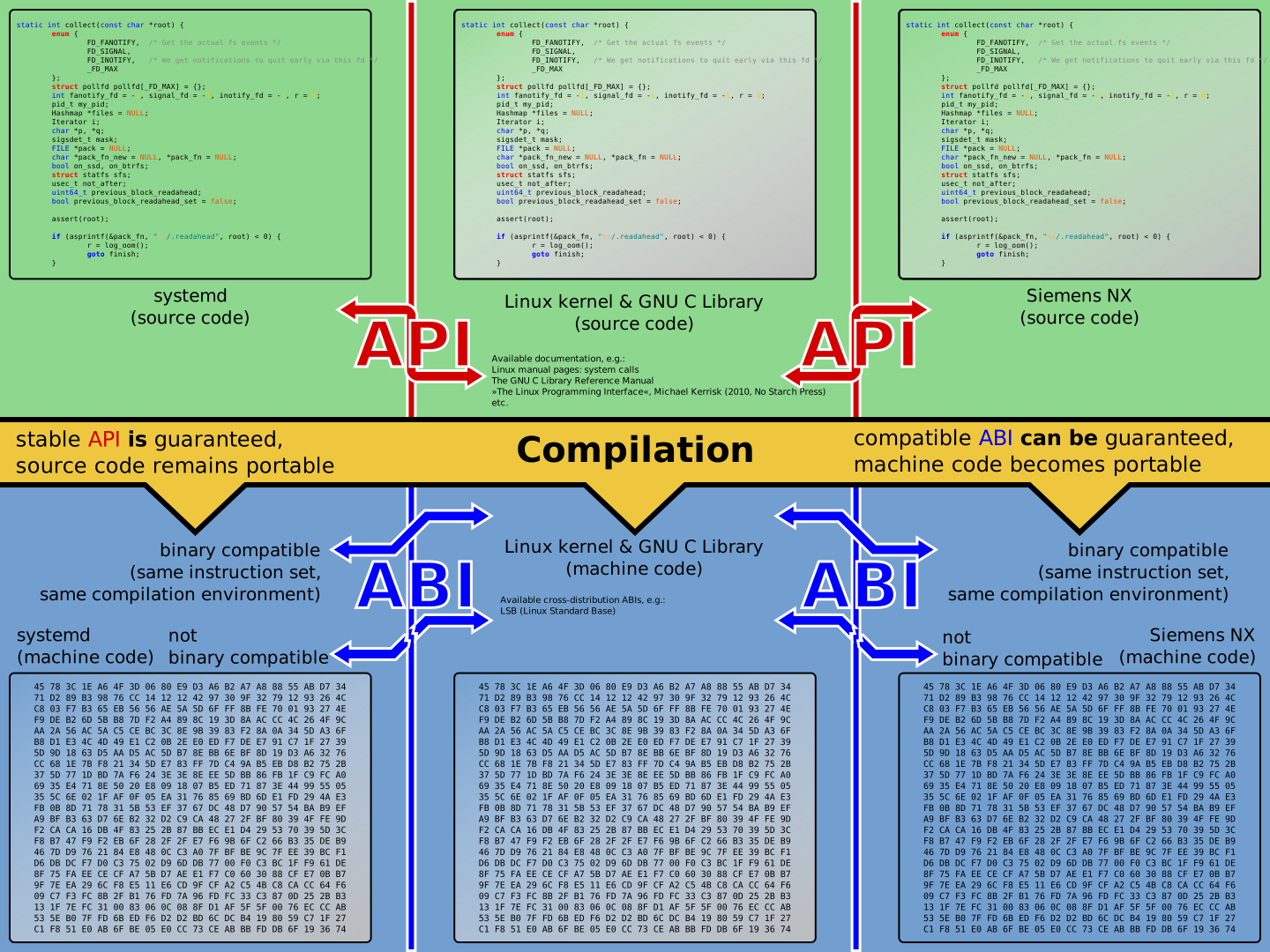
>You may have heard another slogan when talking about C: “C is portable assembler.” If you think about this slogan for a minute, you’ll also find that if it’s true, C cannot be how the computer works: there are many kinds of different computers, with different architectures
As with many things, this phrase is an approximation. C is a portable implementation of many useful behaviors which map reasonably closely to tasks commonly done on most instruction sets. C programmers rarely write assembly to optimize (usually to capture those arch-specific features which are unrepresentable in C), but programmers in other languages often reach for C to write the high-performance parts of their code. The same reason C programmers in the early days would reach for assembly is now the reason higher-level programmers reach for C.