> Mao Zedong defended backyard furnaces despite the shortcomings, claiming that the practice showed mass enthusiasm, mass creativity, and mass participation in economic development.
At least with sparrows they sort of acknowledged they screwed up. But the steel furnace comment, reminded me of the local municipality, where we carefully sorted recyclables into multiple streams, which later turned out were dumped into a single landfill. Eventually, the municipality told people to stop sorting the materials, and just use the one bin, but people refused and raised complaints. The city understood their error, apologized, and reverted their decision, letting citizens perform their sorting ritual, but in the end still dumped everything into one large landfill.
The Great Leap Forward Poured Down Upon Us One Day Like A Mighty Storm, Suddenly And Furiously Blinding Our Senses.
We Stood Transfixed In Blank Devotion As Our Leader Spoke To Us, Looking Down On Our Mute Faces With A Great, Raging, And Unseeing Eye.
Like The Howling Glory Of The Darkest Winds, This Voice Was Thunderous And The Words Holy, Tangling Their Way Around Our Hearts And Clutching Our Innocent Awe.
A Message Of Avarice Rained Down And Carried Us Away Into False Dreams Of Endless Riches.
"Annihilate The Sparrow, That Stealer Of Seed, And Our Harvests Will Abound; We Will Watch Our Wealth Flood In."
And By Our Own Hand Did Every Last Bird Lie Silent In Their Puddles, The Air Barren Of Song As The Clouds Drifted Away. For Killing Their Greatest Enemy, The Locusts Noisily Thanked Us And Turned Their Jaws Toward Our Crops, Swallowing Our Greed Whole.
Millions Starved And We Became Skinnier And Skinnier, While Our Leaders Became Fatter And Fatter.
Finally, As That Blazing Sun Shone Down Upon Us, Did We Know That True Enemy Was The Voice Of Blind Idolatry; And Only Then Did We Begin To Think For Ourselves.
- Red Sparowes, "Every Red Heart Shines Toward The Red Sun"
For anyone else wondering why each word in this is capitalised:
“Despite having no lyrics, the album (by way of its song titles) follows the story of the Great Leap Forward in Mao Zedong-era China, more specifically recounting the Great Sparrow Campaign, a mass killing of sparrows (along with rats, flies and mosquitoes) that fed on a portion of the harvest and were seen as pests.” [0]
Worth noting that poorly planned "pest eradication" campaigns were a global thing. Here in California they paid bounties on a rather wide variety of perceived pest animals.
That was also when the Population Explosion became a thing, and with it human eradication became a darling of certain people. China tried it with the one child policy.
This is why I was concerned when I heard Google, of all companies, released lab grown mosquitos to wipe them out. I'm curious what happened with this effort. It's not exactly a vote of confidence when the other guy trying to do this is Bill Gates.
History runs in circles. Everybody wants to be an hero, so they will refuse to see the danger or to understand that ecosystems don't grant a second try if you change something and regret it later.
Mao died in 1976. Sparrows still remain extinct in most of China.
Generally those efforts are targeted at disease carrying mosquitoes. There are other species of mosquitoes in the same regions and there aren't any animals that only eat one kind of mosquito.
To add to this, the disease carrying mosquito species like aedes aegypti and aedes albopictus are invasive species in the Americas.
These mosquitoes do some pollination but given that they're invasive it probably wouldn't be a big deal to wipe them out.
Also, invasiveness is true of a lot of pests in North America: the American cockroach isn't American, it's from Africa. Brown rats, red/fire ants, and wild pigs are also imported/invasive.
a complication to eradicating a invasive species is when that species has replaced a native species ecological niche. getting rid of it at that point may cause more problems then it solves.
I was more referring to their work with malaria. I suppose it’s up for debate how much good they have done, but the scales weigh petty clearly from where I sit.
Bill Gates foundation is also sponsoring GMOs in Africa. These include lab designed mosquitos that can be introduced in the existing population to eradicate mosquitos.
Someone once commented to me that rather than blaming Mao personally, the blame for the negative consequences of The Great Leap Forward and Cultural Revolution should be placed on the systemic forces that legitimised the absence of domain experts in policy making.
It's a nice sentiment but I have a gut feeling that these kinds of frameworks - where blame is taken away from people and attributed to abstract concepts - lead to worse outcomes long-term. Is that gut feeling just my evolutionary instincts talking or is it a sign of something useful?
Well, where did those systemic forces come from? Does it take your right back to Mao? (I have no idea, it just seems curious that suddenly you'd have these systemic forces cause huge problems that didn't exist before...)
"It's systemic" isn't a stopping point for an investigation. If you diagnose something as systemic it tells you something about how you're gonna have to fight it, but nothing really about blame. E.g. if you talk about the effects of systemic racism in the US the blame isn't abstract, you can clearly trace back many policies, biases, and differences to active, individual racism over centuries.
Official CCP position on was Mao 70% right and 30% wrong. There wasn't lack of domain experts per say, rather Mao pursued modernization agendas at aggressive rate, one that traded lives for progress. 4 pests / killing sparrows didn't lead to famines, the bureaucracy trying to hit Maos KPIs did. Which does not necessarily lead to...
>worse outcomes long-term
Contrary hot take. PRC post WW2 traded lives for progress was net good for long-term outcomes. Mao was bad statesman for right goals, he was excessive and did the hard things sometimes poorly, but it was important to do them none the less. The great leap forward killed millions, but ensured PRC also had the highest industrial capacity amongst developing peers after. Cultural revolution broke traditional social structures = 90%+ unified polity, speaking one language. Purging intelligentsia also overkill, but still had STEM priorities right, both nukes + first satellite developed in this era. In aggregate, disruptions setup/enabled PRC to exploit mass modernization efforts, established industrial base, and plenty of fungible bodies within a few generations instead of century+. Add oil on cramming developement atrocities to develop. Incidentally this is why pluralism of India and old practices (caste) etc is holding up development, India systemically couldn't destroy to renew, now it’s dragged down by the baggage causing 100s of millions of avoidable deaths and even more bodies with stunted development - a few decades of prolonged developing world infant mortality and food insecurity adds up. Treating human capital as actual capital is not nice, but it's effective.
Hard to say if this was actually his thinking at the time, but he's also known for declaring: "I’m not afraid of nuclear war ... China has a population of 600 million; even if half of them are killed, there are still 300 million people left."
Yes, but effective. Manifest some destiny. Future generations reap reward. All of sudden it's 5% bad and 95% good. Maybe 10% bad and 90% good during periods of introspection. The sins of founding father(s) are easy to cleanse.
You can commit atrocious evil without reaping rewards. It is extremely doubtful that Mao contributed any good. Read any book like Mao’s Great Famine or any other book detailing Maos life and exploits. He was a psychopath who refused to admit he did anything wrong. He was also an ephebophile, sleeping with girls as young as 14. Did that contribute any good?
And founding fathers owned slaves. Mao commit atrocious evil in service of greater eventual good and be acknowledged for it. Celebrated even. National history does a tally of net achievements where personal evil/vice like diddling kids and owning people has never been a deal breaker, even less so for founders.
Agenda driven Mao books don't highlight how Great Leap Foreward and Cultural Revolution both indispensible net good for PRC state building by actual relevant metrics. In 1980s Worldbank summary of PRC progress from post WW2 to 1970s (significantly overlapping Mao's reign) concluded relative to low-income peers PRC was significantly more industrialized - national production share 35/40/25 in agriculture/industry/services vs 40/25/40 average in low income bracket. 40 industrial share around middle income levels, supported via higher per capita energy consumption i.e. 3x India). State provided services were also assessed to be far more effective in meeting basic needs vs low income counterparts, with life expectancy in mid ~65 vs 50 for low income. PRC's 65, was again high end of middle income despite being PRC growing from low income. That's +10 bonus years x 900M lives. WB remark was "outstandingly high" and PRC's "most remarkable achievement during the past three decades". Meanwhile Mao bios: he slept with teens, GLF, CR bad. Mao trading lives in the 50s to front load industrialization/workforce development, and then drag masses into modernity by beating out the 4 olds was excessively executed, but not wrong. Right enough that it's better to be overzealous than conservative/not at all. Again, see India. The ledger on Mao doing net good is pretty clear to me - significantly more good than most other leaders who nation build in other low income countries fraction the size of PRC with better starting and operating conditions. Maybe Mao's an unrepentant psychopath, but nobel prizes have given to people whose done less.
IMO Mao is "successful" BECAUSE he's a psychopath. Like he's not a great statesmen - a great statesment would still want to industrialize and normalize culture like Mao, but they'd opt for the peaceful, 50+ year marathon. It takes a psychopath to think, naw, we'll sprint it in half and deal with the bodies. And use that psychopath energy to new regime in line to execute vision. Utlimately, it worked out, and ironically why he's bad statesmen = great founder.
>So what you’re saying is, India is badly in need of a cultural revolution?
Maybe 50/60 years ago post partition. But too late now, IMO India system finally built up some momentum + favourable external conditions while starting very precarious transition period. IN trending towards 1.7B medium term with weaker state capacity than PRC dealing with 2/3 that amount. 1/3 of PRC household still medium income developing poor. Worst thing they can do is try massive restructuring that reduces state capacity further, they're best course is to be doomed to continue muddle along which at India scale might still mean great things for fraction of population. Unfortunately, my guess is that means 40%+ of workforce trapped in subsistence farming and weak female labour participation bordering on repressive Islamic country level. Too much people = demographic curse, India likely not going to maintain growth to keep up with even new (male) job demand, will get old before rich, basically the worst case scenario for PRC demographers that slammed through family planning / one child policy. On the other hand 1/3 of India doing well + geography makes her a formidable power.
E: One useful socially disruptive thing India can do is massively incentivize inter cast marriages to demolish cast within a couple generations. Basically open limited pool of tier1 / high income opportunities to more candidates and select for the best. Also prevent brain drain.
wasnt Mao planning geared toward a "forever war" against the bourgeoisie, to explain putting industrial capacity toward "military" needs in uneconomic areas and/or most of other nation building projects? All obviously limited by Mao dumbness.
Deng Xiaoping regeared the nation apparatus toward a non-antagonistic way in the "hide your strenght, bide your time fashion", kicking the economic boom.
Obviously the chinese top-down approach is showing its shortcomings with the impendent economic & demographic collapse.
India is already at a sustainable demographics growth, only its (muslim) minorities are prospected to grow at unsustainable rates
Mao did 101 nation rebuilding on steriods, basic handbook of land reforms, creating mass cultural identity, spam primary industries to get out of agrarian economy. Progress wasn't just limited to Mao's dumbness but the peoples. PRC was a blob of unskilled peasants, shit tier human capital, vs Mao had technocrats advisors. If anything he was smart enough to realize at PRC population scale, he can spam lives for progress. Get millions of peasants involved in industrialization and some/sizable talent will manifest in right of bellcurve. Talent that Deng took advantage of. PRC wasn't going to become factory of the world without Mao raising workforce skill and making sure everyone spoke mandarin - fungible bodies that can migrate to factory work. Mao/Deng external conditions also weren't up to PRC alone, post WW2 west wasn't going to get friendly due to how blocs developed.
>PRC collapse
Still top performing economy in it's class, enviable growth in real terms while moving up value chain. Meanwhile US labels PRC most serious systemtic competitor with capability to displace, while pouring inordinate resourses and adopting PRC style industrial/tech policies to compete. That suggest it's showing it's strength more than ever. Imitation most sincere form of flattery
>demographic collapse
...
>India
PRC is in process of exploiting THE greatest high skilled demographic divident in human history. The kind of divident actually involved in building advanced power. Like of all areas CCP top down approach is showing it's strength, it's demographic planning. Reduced birth rate higher than expected but the TLDR is PRC demographers did rub their 2 brain cells together when projecting family planning in 50 years ago and right now PRC is in roughly on course in terms of predicted development phase -> fear get too old before getting rich with too much people, limit births, peasant parents have mobility to work in factories, concentrate wealth to educate/upskill 1-2 kids, educated generation move up value chain.
India is not at sustainable demographic growth. India is trending toward basically the NIGHTMARE scenario that made PRC implement family planning in the first place. PRC system with much more state capacity than India wanted less people because it knew uplifting 1B+ was going to be monumental / impossible task. PRC still dealing with 500M (skew old and resigned) people that got left behind with 5x GDP per capita, with high savings and home ownership rate. India is going to end up twice+ as much unproductive workforce (skew young and rebellious) with fraction of state resources/power to support. Demographics is more than pyramid and TFR. Like the only benefit of Indian population is they're vegetarian (because that's what prolonged poverty ingrains in culture) which is good for food security.
I didn't realize sparrows ate insects too. The rule of thumb on the farm was "swallows good, sparrows bad". Swallows ate insects and sparrows ate grain. Maybe China could have replaced sparrows with swallows but that would probably have led to a different kind of disaster since importing species has a horrible track record.
Swallows will only eat flying insects and catch them in the air. The common house sparrow typically forges on the ground. The intersection of the insects both species eat is probably close to zero
The sparrows were just a sideshow to distract from the famines cause.
Most famines were caused by the culture of face and the nature of the party. The party dictated a plan, and as failing the plan and making the great leader loose face, ment the local governments loosing face would get them Maos wrath, all the members of the party reported success when it came to harvests.
So Mao collected the surplus and sold it to the soviet union, who he with his inferiority complex wanted to impress. After that, starvation raged, and he knew. They all know, but feign to not know, to keep face. Instead, superficial measures are taken.
Like hunting scapegoats, spreading crude conspiracy theories inside the country, or hunting harmless sparrows. Busy work to detract from the actual cause.
And nothing was learned from this, cultural change was avoided and now its time to go full circle.
This. Killing the sparrows didn't help, but it wasn't the main cause of the famine. It was the same as Stalin's famines, and he didn't try to get rid of the sparrows. It was just a matter of taking away all incentives for farmers to farm, abusing them, and then using whatever food was available as a weapon for exacting compliance in the ensuing famine. Using food as a weapon means making the famine worse. Add to this all the mismanagement that goes with central planning, and there's a problem.
And after that, rewrite history, to make it seem like an accident. After all, the plan of the party could never be horrible.
Same today, building more coal plants, while half of the country in the south is sliding towards a wet-bulb scenario. 400 Mio living in an area, that could become uninhabitable within a human lifetime, and the plan for that? Get rich faster and run, fuck the peasants, obviously.
The chinese deserve some better government of there own choice with some longterm planning, that poured the money into actual working science, to solve the problems they got. But for that this face nonsense has to vanish first.
While there are dangers to bad top-down management, the criticisms laid out in this thread can still apply to the CPC and Chinese mainland society today, but they don't suffer from famines on the same level anymore.
I don't think they disagree with the goal and intent of rapidly industrializing China from peasant-based into urban workers. They will still uphold Mao's legacy even if they disagreed with his excesses and failures. They are about economic development because it is a required stage for their goal of achieving socialism and communism. Economic development is their longterm planning and "working science."
The lack of famine, is definitely the achievement of the Chinese people and companies. Covid lockdowns showed that even with tremendous wealth a missmanaged government can create starvation..
Part of Mao's enduring legacy was his concept of the party line adapting to the will of the masses, and the sparrow extermination campaign was a failure in adapting the party line to this farmer discontent too well.
Mao did change Chinese culture, but it was by purging Western-style intellectuals and promoting mass organization to take command from the bottom-up, because he saw people on the ground being more correct than intellectuals who might not apply their learning to the actual conditions.
The successors after Mao adopting Deng Xiaoping's liberal attitudes towards economic development can be seen as a Party rebuke of Mao's policies. Yet they will still uphold Mao's legacy.
Not really. Climate change is a multiplier or interwoven with lot of those other problems. Plus burning fossil fuels is so central to our economies that we haven't even stopped co2 emissions rising.
If we'd actually focused on co2, rather than the less than minimum effort made so far, then maybe there'd be more space for the other problems. Instead this one problem looms larger and larger.
Look into the work of Tony Seba: renewable are on an exponential growth.
Tesla Master plan 3 highlight the step needed to fully transition
Bjorn Longburgh explain in his book and interview what are the different priorities and costs associated with the different way we can do good in the world.
I am super into renewable, but climate change will not be a problem at the current speed of innovation. We should focus on making the poor richer so they then can care about the environment. We should also tell young people to have kids, that there is not too many people on the planet and we should be way more careful with the risks of nuclear war.
Not too long ago we were afraid of widespread famine in the 2000 and the return of Ice age, and probably many others thing.
Does he have a good answer for the problem of overgeneration during the summer months, and undergeneration in winter? If you run the numbers on battery energy density, cost, and what it takes to run an efficient heat pump, it seems clear that renewables alone aren’t quite a solution yet. I’d love to be wrong, though.
I don’t know for Musk, for Seba the solution now is overgeneration: it’s more cost effective to have excess solar than to have enough batteries.
The advantage is that you have period were you have free energy if a business find a way to use it. He think that as that become common more more business will find ways to take advantage of it: H2 generation, heat storage, steel/ciment, and other things we are yet to find.
I came to the same conclusion when I installed solar on my motorhome, it’s was way more effective to install "too much" solar so that I have enough for the night of a gray and cold winter day. Otherwise I would had to pay 10X more in lithium batteries. In a summer sunny day I use a fraction of the power. hopefully with a large grid and many free agent and an efficient market the free energy will find uses.
On the other side of the coin is the anarchy of thought that exists around COVID. It's almost like humans societies are a complex series of trade offs irreducible to the simplicities of total authority or total anarchy.
And whoever publicly even doubted the decision of Mao was labeled as right-wing who spread misinformation, or counter-revolutionaries who sabotaged the great socialism movement. Maybe there is some truth in the question: who's the arbiter of information?
I honestly hope that people didn’t downvote the comment because of the mention of “right”. The “right” in China (or the third Internationale in general) is akin to the liberals in the western world.
The whole point of the comment is that truth matters and freedom of speech matters and government or any entity alone can’t be the arbiter of information
That sounds like an unfalsifiable claim. Do you have any evidence supporting it, or are you "just asking questions"?
Edit: I deserve to have been downvoted, I have misinterpreted the context of "right" in the parent post and they have educated me with articles in turn
I mean struggle sessions were a real thing. [1] Suppose it's hard to say that any particular person was forced into a struggle session for saying that killing sparrows was wrong, but they were absolutely a thing and mostly used to quell dissent and spread Maoism.
History books? The evidence is abundant, it's weird that this is even in dispute. Not sure what the Chinese term was but the Soviets used the word "bourgeoisie" or sometimes "kulaks" where today we would say right wing/capitalists, and they used пропаганда (propaganda) for what today we would call misinformation. And counter-revolutionaries were just counter-revolutionaries, no change there.
The only bit about hintymad's claim that's false is that the people who publicly doubted Mao weren't labelled as things. They were just executed.
You're in luck, there's a whole wikipedia page covering the named offenses[1] of the cultural revolution. Rightist, reactionary, and class-enemy seem to have been common based on my reading.
> Not sure what the Chinese term was but the Soviets used the word "bourgeoisie" or sometimes "kulaks"
Yup, Chinese did use "bourgeoisie" too. It's called Xiaozi (小资), though the connotation of the word today has drastically changed. Before and during the Culture Revolution, the word referred to those who didn't have complete conviction in the Revolution and were attracted to the "corrupted life style" of the western world. However, bourgeoisies were educable. If they refused the education, whatever that means, they would turn into the right.
Oh my god, are you serious? Or I just naively assumed that the dark history of China back in the 50s and 60s are well known? The Great Leap Forward. The Anti-Right Campaign (BTW, “right” in Marxism terms are akin to the left in the western world). The Four Cleansing Movement. The Campaign to Eliminate the Four Pests… Millions of people died of hunger and millions more lost their civil rights for decades! People who questioned whether an acre could produce more than 5000KG of rice got persecuted.
Thanks, I did not know it was literally called the "Anti-Rightist" campaign and I see I misunderstood the comment and implications you originally made. Sorry for that.
Even asking questions is not a bad way to keep the conversion going. Not every sentence has to be proven logically and supported by extensive research and references.
How does the targetting of the sparrow species for annihilation in China compare to the post-Columbus ongoing deforestation in the Americas's? Xi does have the ecological health of the environment on his policy priority list which is a change from previous leadership driven by slavery to economic devop. There are documentaries on little birds by the sea. They have their place.
> post-Columbus ongoing deforestation in the Americas's
It's an open question how much of the Americas were actually heavily forested before western disease killed 95% of the population.
A lot of what Europeans saw when they explored was basically post-apocalyptic wilderness which had sprung up in the 100-200 years since the vast majority of the population was killed.
Practically no other event in human history comes close to the ecological and cultural destructive impact of the early colonial period in the Americas. But because of that, it should not be used as a yardstick for anything else. "It's not the worst thing ever" is a poor defense of anything.
On a similar note, there's a danger of comparing "the early colonial period in the Americas", a 300-400 year period containing many distinguishable catastrophes, to anything not of equal scale. It's kind of like comparing an apple and a whole apple tree.
> Practically no other event in human history comes close to the ecological and cultural destructive impact of the early colonial period in the Americas.
This was 100% a problem caused by central planning and failure to consider second order effects.
But at the core the problem was blindly following the suggestion of a leader who is not making evidence based decisions. This will always end in tragedy.
I regret to report that such leaders can and do emerge under every economic system.
Maybe free markets are less susceptible to them because the leaders have less power over people’s lives in free markets.
Perhaps the takeaway should Be to limit the power our leaders have over us because the world is complex and a central plan will never encompass the realities of every individual.
After reading several autobiographies of people who lived in the USSR, I've started to think that material shortages are actually the deliberate goal of people who run communist countries. More succinctly, without material shortages, communist-inspired governments rapidly cease to exist.
If the People are not presently experiencing a material shortage, then they do not rely on authority figures to go about the daily business of feeding and policing themselves. Without regular contact between the People and the central authority personnel, it becomes impossible for the central authority personnel to supervise and grant/revoke permissions for them. Supervision and permission were the two components absolutely required for the government of the USSR to continue to exist--supervision allows for the early identification of threats to the government structure, and "permission" systems create excuses for the government to deploy the violent martial caste against threats to their supremacy.
(It is self-evident that people don't like living inside systems where they're constantly monitored and supervised; millions of people around the world work very hard to leave supervision-heavy countries for less-supervised ones. Also, children everywhere chafe against school, and prisoners chafe against prison.)
So I don't believe a truly centrally-planned, communist government will ever generate a useful material surplus (food, medicine, tools, etc.). If it did, the People who enjoyed the results of the surplus would immediately stop participating in the centrally planned processes mandated upon them by the planning committees.
Conversely, the first thing any centrally-planned government will do is organize itself in such a way that all important goods become scarce, so that it can guarantee regular contact points with citizens and set up a robust system of permission granting and revocation.
So I think its fair to say the USSR, China, Cuba, North Kora were a form of communism that had the following characteristics.
1. Authoritarian
2. Central planning (perhaps the same thing)
3. Slow to change
These are all valid criticisms based on what we know from history, etc. I think there is a bit of nuance here though based on a glance of https://en.wikipedia.org/wiki/List_of_famines and some basic history.
1. China did experience some horrible famines, particularly the '59-'61. However, they had experienced these, ~20years+/- 10 years, since at least the 1800s, perhaps 1700. That is well into royal rule prior to the revolution. Particularly the 1810, 1811, 1846, and 1849 (Four famines, ~45Mil dead). Just saying, objectively, not sure the average peasant was more or less likely to experience a famine under the royal rule or communism.
2. Russia and the surrounding neighbors that were consumed by the USSR, seem to have a similar story. The Tsar's in particular were not very good at economics, logistics, or resource management.
3. Post WWII cold war meant virtually every communist country was isolated and sort of by definition a centralized state. They were locked out of the emerging reserve currency (Dollar). They could not freely go to market with their goods. As well as they were all sort of frenemies of each other (see relationship between Korea, China, and USSR for examples).
Look I'm no great lover of communism, I sat through the same U.S. history classes in the 80's-90's, saw the wall fall on TV, etc. That said I think the one thing no one acknowledges is that people don't start revolutions and try out radical types of government because their lives are going just swell! Shit maybe its to much Civ as a kid, but I think its important to be honest about the pluses and minuses of government and the specifics of the people, region, and time period that these changes occur.
> people don't start revolutions and try out radical types of government because their lives are going just swell!
of course they don't, and i deeply sympathise. but what they always seem to end up with like genocidal maniacs like mao and stalin. both communists. and of course, in the west, we had hitler. but after 1945 i would say human life has improved in the west - more than i can say for china (despite industrialisation) and the "former" ussr.
i should say i am someone of broadly left-wing leanings.
In the USSR and China, the large scale deaths were linked to failures during economic development. Despite the failures, there were improvements in quality of life. (The CIA factbook about USSR nutrition being on par or better than the West being one example.) They end up being a class ahead of the poorest of the third world. The issue was that the USSR did not catch up to the leaps the West made. China is catching up using their illiberalism to enforce protectionism and national economic development. If anything, this seems to emphasize that economic development requieres global trade, and this was an issue with the USSR and early China.
> In the USSR and China, the large scale deaths were linked to failures during economic development.
no, they were caused by ideological stupidity (stalin: look up "kulaks", mao: see cultural revolution and great leap forward), and both states being governed, by terror, by paranoid megalomaniacs. read a history book.
> this was an issue with the USSR and early China.
did the west not provide the ussr and china with enourmous amounts of military, economic and technical aid during and after ww2 (selling the ussr jet engines, for example)? oh, yes, it did!
The ideological stupidities were motivated by the goal of economic development. Stalin thought kulaks' economic interests were holding back the centralizing industrialization of agriculture through collectivization. Mao wanted to move from a peasant-based economy to industrial-based through the great leap. (The cultural revolution was a populist cudgel to make the Western educated intellectuals adapt and submit to the local Chinese conditions.)
---
I wouldn't lean on wartime subsidies too much because they are extraordinary circumstances. The USSR focused on self-sufficiency to the point of foreign trade only being 4% of GDP in 1985. China started opening up after Nixon normalized relations.
So the ideas of communism is what cause people to kill off sparrows or was it just bad information and bad/incomplete research on what role sparrows played
Killing off sparrows is only one example of crazy/random/destructive policies that are a regular occurrence under communism. Some others (not in any order):
- The USSR sometimes overproduced cigarettes, so ran ad campaigns to convince people to start smoking.
- The Holomodor, in which Ukraine was starved by exporting (stealing) all its grain, including the grain needed to plant next season's harvest, and when starving peasants tried to flee they were then banned from leaving.
- In modern China, ghost cities full of buildings nobody is living in.
- Stalin's mass execution of basically everyone who mattered in Soviet society, including virtually all of his military and intelligence leaders, which put the USSR into such a weakened state that Hitler is on record as saying now is the time to strike because the Soviets will never be so weak again.
- The single-minded obsession with steel production.
- In NK the government maintains a list of approved hair cuts. There are 28 approved styles and anyone with a haircut that's not on the list will be punished. Additionally, punishment for crimes are often levelled against the families of the criminals.
It's inevitable that these sorts of things happen because the goals of communism are deeply unnatural (e.g. banning markets, central planning) and can therefore only be implemented through totalitarian power, which lacks sufficient bandwidth and flexibility to incorporate feedback loops. So everything goes off the rails because the people making decisions are blinded to the outcomes.
The goals of communism are to resolve class contradictions, which "naturally" happened in the case of feudalism ending. Communist states attempt to accelerate and resolve them through stages. This is where they can seem "unnatural".
On the flip side, there may not be anything to inherently prevent capitalism from doing similar things too. The USSR tried to have a much more planned and state managed version of capitalism to progress through the stages of socialism. The central planners decided where profits went instead of private property holders. If these property holders were to have control of a political system, then there is the potential they could enforce similar things.
I'm really not sure that anything in the USSR could be described as capitalism, not even a state managed version of it (which sounds like a contradiction). They really saw capitalism as the enemy and one of Stalin's weird mental hangups was an insistence on seeing Great Britain as the center of global capitalism.
The power and control wielded by centrally planned economies allows for wide-scale top-down dictation which vastly exceeds that of the democratic-capitalistic states. Thus enabling destruction on this scale. It's not about specifics of ideology, it's about how much authority is concentrated in the hands of the central planners. If central planning only works in a world where perfect knowledge of the state of the economy is possible, then central planning can never work.
Fun side note: I really love The Culture sci-fi series by Iain M. Banks, for it's depiction of a truely utopian, classless, centrally planned Galactic Empire. As it turns out, this is the ideal form of human social organization provided that the central planning is done almost exclusively by post-singularity benevolent AI ( who are essentially gods). This is about the only scenario where central planning seems viable.
culture minds are not always so benevolent (though they may tend to be towards culture human citizens) - this is one of the major threads of the series
Just want to expand on this comment, because it can be easily handwaved away with a "our version will be democratic". The level of power afforded to central planners is a stabilizing force away from distributed power, and towards tyrannical governments. Every government's primary objective is to retain power for themselves, else how would they achieve their goals? Every other objective must be subservient to this, because no other objective can be achieved without it. This is true be it a state is democratic, monarchic, communist, or whatever. Give a governing power 100% control of a national economy, and they will use it to entrench their own power. If they fail to do so, they will lose power to those who will. Benevolence cannot be relied upon as a long term stabilizing force.
The ideas of communism are that of the command economy, total centralization. Someone at the TOP decides all of this stuff. This means that if someone at the top (who is not to be questioned, see Mao's other wacky hijinx) makes any kind of error, well, you don't hear about it until it is unavoidably terrible. No early feedback, everyone is afraid to give it to you.
In a more decentralized setup, it is bottom-up, and suddenly "hey this isn't working" gets propagated. Also, a peer is more willing to call you on your bullshit, but if you're a dictator, you just get yes-men.
Essentially, the setup was such that anyone less than a perfectly informed leader who never made mistakes would wreak havoc.
The political system was democratic centralism where there are levels of indirect democracy starting from the local levels of factories and villages, which elect up to a legislature, which elects an executive top command. Power is indirect granted bottom-up but decisions are wide-spreading from top-down. Ironically, there's a level of decentralization in China that's tolerated as long as they meet government goals. (I'd say at times it's too decentralized, so bad behavior is too tolerated as long as it achieves economic directive goals.)
>So the ideas of communism is what cause people to kill off sparrows or was it just bad information and bad/incomplete research on what role sparrows played
We can try this framing in another 100 yr drought scenario and see what gets blamed.
"So the ideas of capitalism is what caused the Dust Bowl or was it just bad information and bad/incomplete research on what role grass/trees played when creating vast plots of dry overplowed land"
It's communism (or more specifically, Marxism). This sort of outcome was predicted by Benjamin Tucker as an inevitable consequence of Marxist socialism in 1888, essay: "state socialism and anarchism", long before any implementation of Marxism came to being
If you really want to get into details, it's Marxist-Leninism. Much of the Soviet-style political system came from Leninist theories of achieving Marxist goals. Lenin said it himself, it's state capitalism. (Stalin then called his implementation first stage of socialism.)
I've read about this several times, and I'm not surprised the story is popular. Many people see China as a foe, so they like to smear it. That's alright, but anyone should be extra cautious when a story is just what most people want. Stories tend to inflate and bend to please their auditory.
For instance, consider the claim that China had to import 250,000 sparrows from the USSR. Where does it come from? This article seems to be a mash-up of a few sources, mainly Wikipedia. Indeed Wikipedia has the same claim, which is sourced from the book "Mao: The Real Story", by Alexander Pantsov. The said book has just a single sentence about this: "As a result, the Chinese even had to import sparrows from the Soviet Union." A vague assertion: no source, no date, no number of birds. Searching the web only showed many deformations of this (imported from Russia (sic), or USSR and Canada, or imported a million sparrows...). I couldn't find more about this in JSTOR and SciHub.
Overall, I haven't see anything compelling about this detail (importing sparrows) and not much about the main claim (killing sparrows is the main cause of the famine).
One last thought: pesticides have killed scores of birds and insects, especially in the USA. Probably much more than the Four Pests Campaign did. And ecological imbalances have obviously suffered during the last decades: among others, bees are waning in many countries. It seems a bit hypocritical to blame Mao in the past and forget Monsanto-Bayer and Co in the present.
Google Translate says the USSR sent wagonfuls of sparrows. Btw Mr. Smartypants, no need for your "(sic)" "Russia" is allowed too, it'd be like a country asking the EU for help and Germany responding, Russia was a country which was part of the USSR.
The Russian article references papers written by Chinese and Russian scholars, I find it peculiar that you're wary of Western propaganda but yet rely on just English-language sources...


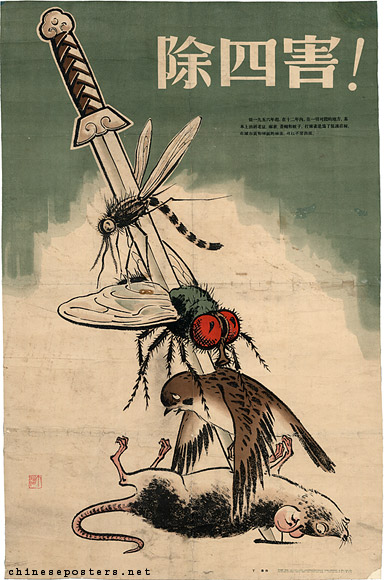
That was surprising. I knew about the sparrows and the famine, but had no idea about them being imported later by the hundreds of thousands.
> The diversion of labor from harvesting crops to steel production and construction meant crop supplies were left to rot in fields.
That was often done in badly built smelters which were not able to produce quality steel https://en.wikipedia.org/wiki/Backyard_furnace
From the wikipedia article:
> Mao Zedong defended backyard furnaces despite the shortcomings, claiming that the practice showed mass enthusiasm, mass creativity, and mass participation in economic development.
At least with sparrows they sort of acknowledged they screwed up. But the steel furnace comment, reminded me of the local municipality, where we carefully sorted recyclables into multiple streams, which later turned out were dumped into a single landfill. Eventually, the municipality told people to stop sorting the materials, and just use the one bin, but people refused and raised complaints. The city understood their error, apologized, and reverted their decision, letting citizens perform their sorting ritual, but in the end still dumped everything into one large landfill.