> You know, I told you about how it took 20000 lines of C code to generate the original piece. I’m pretty sure Dr. Moorer had to create almost everything by hand so that is not very awkward. But you know, we’ve been sctweeting for some time, trying to fill stuff into 140 characters of code. So for the fun of it, I tried to replicate the essential elements of the composition in 140 characters of code. I think it still sounds cool, here is the code (this one uses an F/E fundamental):
That's insane. Looking the person up, I guess it isn't a surprise that they're working at Teenage Engineering now.
The demoscene is one of the areas of niche computing that's always interesting to me, even though I completely lack the skillset and even the interest to do things like that.
Huh. That resolution was not at all what I expected, but somehow just as good.
I'm no good with music theory, but this sounds like it resolves to a diminished chord as opposed to the original major chord. It's deeply menacing instead of triumphant. I really like it.
To me it sounds almost like converging Shepard tones from both sides of the spectrum, and I agree that the resolution is not the same chord (or at least there's a different quality to it).
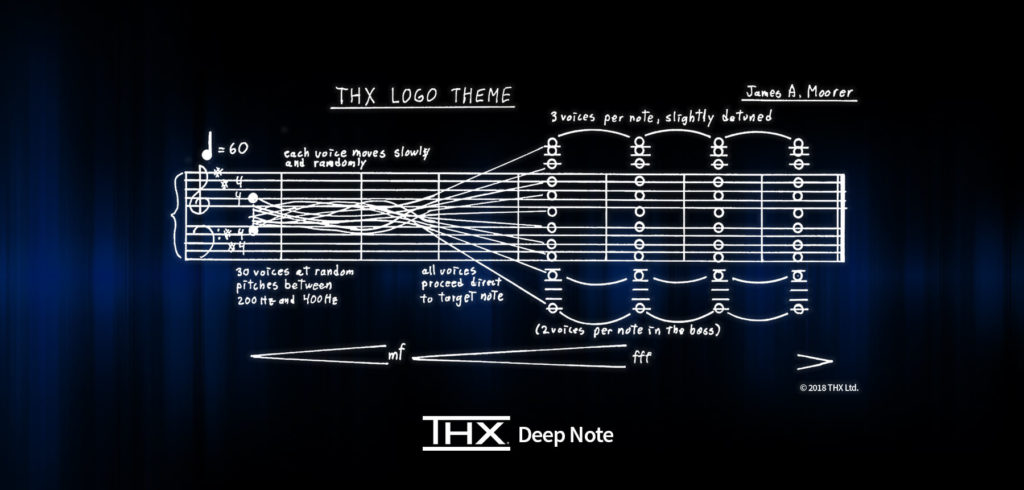
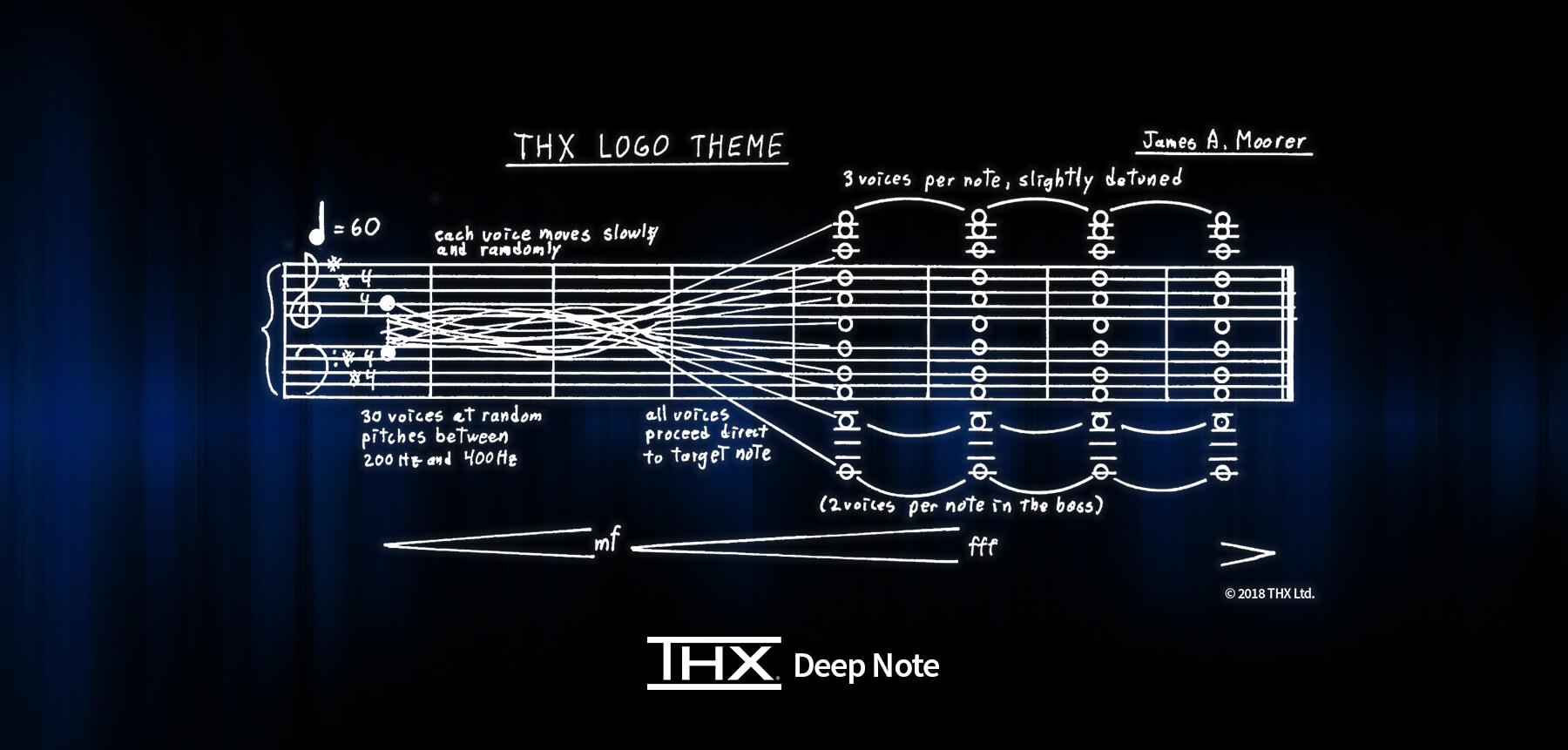
It's always fun to go on a THX Deep Note rabbit hole trip, finding all the people who have replicated it.
Here's a neat example I just found where the original sound is just repeated and mixed at increasingly high numbers: https://www.youtube.com/watch?v=CvipzurlCK0. Pretty awesome.
I remember some years ago I saw a YouTube video of a guy who did a recreation of this in some sort of Audio Programming Language (it might have been SonicPI or something).
He started off by claiming he wanted to create the sound of a hundred bees or something, then he coded these, and bit by bit he re-created the Deep Note. Since the video wasn't titled after that, it was quite a surprise.
I can't seem to find that video anymore, if anyone has a link, please share it :)
Q. A couple of people have already asked me about how you wound up with 20,000 lines of code in the original. I expect there was a fair bit of manual mucking about?
A. Actually I made a mistake with that 20,000 lines of code statement – that was just off the top of my head. I need to correct that if I can figure out how, but it also depends a bit on what lines of code you count. The original 30-year-old C program is 325 lines, and the “patch” file for the synthesizer was 298 more lines. I guess it just felt like 20,000 lines when I did it.
Given that it was written and debugged in 4 days, I can’t claim the programming chops to make 20,000 lines of working code that quickly. But, to synthesize it in real time, in 1983, took 2 years to design and build a 19” rack full of digital hardware and 200,000 lines of system code to run the synthesizer. All that was already done, so I was building on a large foundation of audio processing horsepower, both hardware and software. Consequently, a mere 325 lines of C code and 298 lines of audio patching setup for the 30 voices was enough to invoke the audio horsepower to make the piece.
1982 (pre-ANSI C!), without any audio library or hardware driver to handle things for you, so 20,000 lines of code encompasses the whole audio stack.
With that in mind, the 140-char snippet at the end is an unfair comparison, since that leverages a sophisticated and mature audio stack provided by the OS and Supercollider.
A universe where you are not standing on the shoulders of giants.
For a little context the deep note was released the same year as TCP/IP and the Commodore 64. Source code was mostly shared by printing it in magazines (multi-page printed publications that would be mailed to your house monthly in exchange for a yearly subscription fee).
I don't disagree with you but a comment above shows the truth, that it was 400 lines and 200,000 lines of synth code he didn't write. Anyway, it is still cool.
The repo has slides with helpful links for those looking for a rabbit hole. Especially nice is a podcast interview with the original engineer James Moorer which sheds a lot of light on the implementation


> play{Mix({|k|k=k+1/2;2/kMix({|i|i=i+1;Blip.ar(iXLine.kr(rand(2e2,4e2),87+LFNoise2.kr(2)k,15),2,1/(i/a=XLine.kr(0.3,1,9))/9)}!9)}!40)!2a}
> http://earslap.com/assets/thxdeepsound/soundtweet.mp3
Absolutely crazy how people can fit all these things into these short snippets of code. The demo scene impresses me equally in this.