You don't think about the life of the electrons going through your processors when you code.
Traceroute is a view at a certain level of abstraction. It also doesn't tell you if your packet was delivered using ethernet, wifi or a token ring. It just doesn't matter.
The more you know about how something works the better equipped you are to handle things breaking. It's a safe bet that semiconductor physics and the gate-level construction of CPUs isn't necessary to be a good programmer, but not much further up that stack are things like understanding superscalar processor architecture, how caches work, how CPU protection levels work, etc. Knowing about those things, for sufficiently performance or security-intensive applications, can make a ton of difference.
There's an analogy to networking there, too. You don't necessarily need to know how wave-division multiplexing, BGP, or DNS work to communicate over the Internet. For some categories of problems, though, a little bit of knowledge allows you to punch just a bit above your level.
The OSI model hasn't been accurate representation of ip networking since pretty much day 1. It was made specifically for a different protocol, but in the stack we use today some layers are better split up in 2, some protocols exists in multiple layers. It's a nice metaphor but I think it's time to drop it!
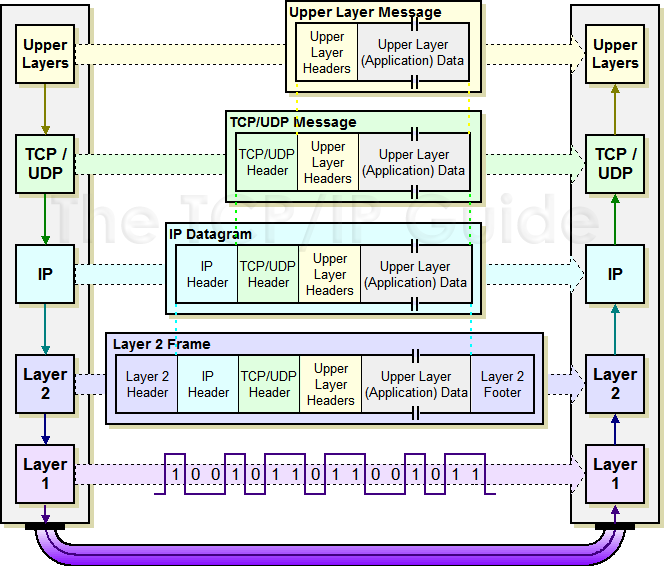
Something that I've noticed that somehow ends up lost when people learn "the model" is the encapsulation aspects.
I don't know if it's missing in people's course work or what, but I've had to use http://www.tcpipguide.com/free/diagrams/ipencap.png many a times to explain how stuff like VPNs work, correct statements like "firewalls don't have a routing table, firewalling is layer 4", explain things like MTU and payload size, or why certain traffic doesn't go beyond a broadcast segment normally.
Personally I think this is one of the better visualizations.
It just doesn't matter until it does. It's fine to work at a higher level of abstraction. But people who understand a lower level of abstraction can do things people will call "impossible" with fault injection exploits, rowhammer etc.
To clarify my previous post, asymmetric routing is strictly an L3 behavior, and ECMP routing can also be an L3 behavior where a router chooses one of many equal-cost next hops based purely on data in the IP headers. The exact behavior of course depends on the ECMP load-balancing algorithm in use, whether it's per packet, per destination, or using a hash. And furthermore whether it's strictly IP or if it looks deeper into the packet and uses L3+L4 headers in its decision making.
Both asymmetric routing and ECMP routing are visible from L3. In the latter case, the routing decision can utilize some L4 data, so some L4 frobbing to get useful data points in practice is necessary for useful real-world diagnosis.
I agree with others that the OSI model is a good metaphor and a framework for reasoning about networking, but it is far from perfect, and the reality for those designing and operating network protocols and devices is messy.
MPLS is admittedly invisible and there isn't a thing you can do about it in the same way that you can't expect traceroute to give you a view of the switch ports it went through on a LAN. Of course it is useful to understand and keep in mind the fact that there may be, sometimes huge, gaps in your traceroutes. A sudden huge jump in RTT from one hop to the next can be confusing when trying to understand and troubleshoot a network issue.


You don't think about the life of the electrons going through your processors when you code.
Traceroute is a view at a certain level of abstraction. It also doesn't tell you if your packet was delivered using ethernet, wifi or a token ring. It just doesn't matter.